Thank you for visiting the cupboard. I now have a new blog here.


Wednesday, 21 July 2010

Anti-Tales: The Uses of Disenchantment Symposium

Registration is now open for this fascinating looking symposium being held at the University of Glasgow on the 12th-13th August. It is free to attend and the full programme is available online here. There is a great range of papers being given and panels with titles such as 'Wicked Women and Feminist Anti-texts', 'Not so, SnowWhite', 'Bluebeard', 'Surrealist Anti-tales', and 'Cinematic Reimaginings'.

John Patrick Pazdziora, whose wonderful fairy tale 'Ragabone' we published in Issue 5 of New Fairy Tales will be giving a paper entitled ‘ ‘‘You Know How Happy Kings Are”: The Anti-Fairytales of James Thurber’. And I am very excited to have been asked to give a reading of my fiction and to talk a little bit about New Fairy Tales. I'll be reading my anti-tale 'Raven', which was published online at Cabinet des Fées, and a new story 'Feather Girls' which is an anti-tale inspired by the swan maiden tale collected by Joseph Jacobs.

At the moment, the anti-tale is an under-researched concept, despite its being a popular form in terms of genre publishing. The symposium's organisers, Catriona McAra and David Calvin, have this to say about it:

The anti-fairy tale has long existed as a shadow of the traditional fairy tale genre. First categorized as the 'antimärchen' in Andre Jolles' seminal Einfache Formen (c.1930), the anti-tale was found to be contemporaneous with even the oldest known examples of fairy tale collections. Rarely an outward opposition to the traditional form itself, the anti-tale takes aspects of the fairy tale genre and re-imagines, subverts, inverts, deconstructs or satirizes elements of them to present an alternate narrative interpretation, outcome or morality. Red Riding Hood may elope with the wolf. Or Bluebeard's wife is not interested in his secret chamber. Snow White's stepmother gives her own account of events and Cinderella does not exactly find the prince charming.

The anti-fairy tale takes many forms. Some revisit and deconstruct familiar narratives (as above) or formulate new stories, characters and ever-afters, relying on and subverting familiar archetypes and plot devices. Following Jolles' seminal, respected text, the subgenre of the anti-tale has become dominant, as writers such as Angela Carter, Neil Gaiman and Phillip Pullman, artists such as Kiki Smith, Anna Gaskell and Kara Walker, and filmmakers such as Matthew Bright and Jane Campion have produced a diverse collage of anti-tales.

(read more here)

The organisers can be contacted with any enquiries at: antitales@googlemail.com. And I would really encourage anyone with an interest in fairy tales, who can get there, to come along and participate. It would be lovely to meet you (and for people who live too far away, I'll report back here after the event).

Sunday, 18 July 2010

Profile: Bluebeard

'Killing wives since 1697'

Name: Barbe Bleue or Bluebeard

Age: The oldest literary version of the story is by Charles Perrault and was published in 1697, but the tale was based on much older oral folktales.

Location: France. There has been much speculation over whether Perrault based Bluebeard on Gilles de Rais, a 15th c. Breton knight who fought alongside Joan of Arc and murdered children in his spare time. Blue-Beard a contribution to history and folk-lore is a book dedicated to the subject, although as the tale is closely related to many other folktales worldwide this link is often disputed.

Appearance: Did I mention he has a blue beard? He does in Perrault's version anyway, a beard which 'made him so frightfully ugly that all the women and girls ran away from him'. He's not to be confused with the pirate, whose beard was actually black.

Relationship Status: Interested in women. But would you want to marry him? Whether you take the tale to be about a psychopathic serial killer, or simply about the dangers of marriage in an age when death during childbirth was more common, he's not a good prospect. Especially if you add to that Perrault's view that the tale is really about the evils of women's curiosity (i.e. serves them right).

Best lines written about him: I couldn't write this profile without getting some Angela Carter in it, in her version of the tale, the title story in the collection The Bloody Chamber, her narrator says of him:
I know it must seem a curious analogy, a man with a flower, but sometimes he seemed to me like a lily. Yes. A lily. Possessed of that strange, ominous calm of a sentient vegetable, like one of those cobra-headed, funereal lilies whose white sheaths are curled out of a flesh as thick and tensely yielding to the touch as vellum. When I said that I would marry him, not one muscle in his face stirred, but he let out a long, extinguished sigh.
Some places you'll find him online:
Bluebeard and the Bloody Chamber, an essay by Terri Windling
An annotated version of the tale, along with history and illustrations on SurLaLune
Bluebeard stories collected by D. L. Ashliman
Bluebeard's Keys and Other Stories, by Anne Thackeray Ritchie
The Grey Woman, a reimagining of the Bluebeard story by Elizabeth Gaskell
Bluebeard's Final Girl, or, The Revisionist, a poem by Veronica Schanoes
The book for Offenbach's Opera of the tale
Bluebeard a 1944 film starring John Carradine (available to watch online)
Bluebeard; or Female Curiosity poster and info about a 1798 performance
Some other tales with murderous grooms: Fitcher's Bird, Mr Fox, The Robber Bridegroom, Cannetella

And if that's not enough Bluebeard for you, you could also try Catherine Breillat's new film. It got a cinema release in the UK on Friday but I've read that it has gone straight to DVD in the US.


There is an interview with Catherine Breillat in The Guardian and reviews of the film in The Guardian and The New York Times.

The illustration at the top of the post is taken from The Sleeping Beauty Picture Book, illustrated by Walter Crane. I love the fact that in this book 'Bluebeard' is published alongside 'The Baby's Own Alphabet', which says something about our changing relationship with the story and with our children.


Previous profiles: Goldilocks, Jack (of the beanstalk fame), Little Red Riding Hood, The Big Bad Wolf

Tuesday, 13 July 2010

When I went to play at the Manchester Children's Book Festival...


(click on the image to see a larger version)

... I had an amazing time. I ran three family fairy tale workshops, in which everyone, from toddlers to adults, had fun dressing up, drawing and creating new fairy tales together. The picture above was drawn by festival illustrator Dai Owen, who came in and magically captured four of the participants in just a couple of minutes (they were busy trying to work out which key would unlock the bird cage in the golden castle, at the top of the glass mountain—they decided a feather key would do it in the end).

I owe a lot of thank yous; to the festival organisers for such a lovely day, to friends Carys Bray and Elaine Wilson, who did a fantastic job running the New Fairy Tales stall, giving away postcards, badges and selling some handmade chapbooks of our stories to raise money for Derian House Children's Hospice. And, to various members of my family (Mum, Dad, Aunty T & Grandma), who were dragged into making everything from crowns and keys to capes and banners! And thank you to Dai for allowing me to share his wonderful drawing.

The festival website is still online, so if you missed it you can still have a nosey at what went on, and the good news is the festival will return in 2012.

Saturday, 26 June 2010

A competition


I've really deliberated over whether to post about this or not. In the end I decided I wasn't comfortable posting about it directly, but I didn't feel happy about not flagging up the opportunity for anyone who might be interested. A UK television and broadband provider (who are part of a multinational media empire) are running a competition looking for tweet length new endings to fairy tales. There are full details posted on the SurLaLune blog here.

The illustration is by the wonderful John Bauer (1882-1918) from the tale 'The Boy and the Trolls, or the Adventure' which is included in Swedish Folk Tales, a book I really treasure (and far be it from me to use my illustration choice to suggest Mr Murdoch is a money grabbing troll, and that one of his companies is simultaneously trying to bag themselves plenty of free advertising via social networking platforms and to associate the use of their services with a 'happily ever after').

Wednesday, 23 June 2010

Some lesser known Grimms' tales

The Old Woman in the Woods by Adam Oehlers

I have several collections of the Grimms' tales, but I've had my favourite since I was seven. It's a big chunky book called The Illustrated Treasury of the Brothers Grimm, illustrated by Luděk Maňásek, with translations by Vladimir Varecha.

The illustrations are peculiar but vivid, the translations are written in a bright, simple style and the publisher is (rather fittingly) called Treasure Press. But, for me, the best thing about this book is how many tales it has in it: 87. Which is still only a portion of the 210 tales included in the Grimms' final (1857) edition of Children's and Household Tales, but it's more than are in the other collections I own. It's a book I can still get lost in.

I often wonder what makes editors choose a small number of the Grimms' tales to publish over and over again, particularly when it comes to illustrated texts and picture books. Perhaps it's because they think readers only want to revisit tales they are familiar with, but there are many other wonderful tales hidden away that I'm sure would become just as popular if they were given the chance.

I think my favourite is The Old Woman in the Wood. It's a strange name for a story in which the said old woman plays only a small (but villainous) part. The tale is really about a girl who finds herself lost in a forest. She is visited by a bird who brings her keys so she can unlock the trees... (I'm not going to say any more because I want to encourage you to follow the link and read it in full).

Some other tales I've long loved but haven't found elsewhere as often as I would have liked are: The Glass Coffin—which features a tiny castle and a princess trapped in glass chests (although AS Byatt has retold this and you can find her fantastic version in both Possession and in The Djinn in the Nightingale's Eye); Jorinde and Joringel—which is a beautiful bird transformation tale; and The Seven Ravens—another bird transformation tale, which features a sister setting out to rescue her brothers from inside a glass mountain.

I have been reading from The Illustrated Treasury of the Brothers Grimm since I was seven and I can't see myself ever tiring of it. In Once Upon a Time: On the Nature of Fairy Tales, Max Lüthi has this to say about the appeal of fairy tales for adults, as well as children:

The fairy tale portrays, in a wider sense than is generally realized, a harmonious world. The confidence from which it flows is transmitted to both those who tell it and those who hear it. Thus, it is no wonder that not only children come under its spell, but that it repeatedly exerts its charm over adults. It gives not only pleasure, it gives form and inspiration; and we can readily believe the report of a north German storyteller that a soothing and healing power can emanate from fairy tales when told to sick people in hospitals. Every fairy tale is, in its own way, something of a dragon slayer.


The beautiful illustration at the head of this post is by Adam Oehlers, whose story 'Dear Little Emmie' features in the latest issue of New Fairy Tales. Adam is extending the story at the moment and it will be published as a book in early 2011.

The tales I have linked to above are from Margaret Hunt's 1884 translation. All 210 tales from this translation are available on the SurLaLune site.

Saturday, 19 June 2010

There's a new issue of Enchanted Conversation online...

...and it features short stories, poetry and essays inspired by 'The Little Mermaid' and other mermaid, nixy and sea witch tales. I can't wait to settle down to read it!

There are also two contests you can enter, one which asks writers to explore what it would feel like to be a "Daughter of the Air" (as in Andersen's original tale) in a poem or story, and another asking readers to suggest a menu for a mermaid-related meal for the journal's Fairy Tale Food Editor (with a note from Kate Wolford, the Editor, to say they do not mean some type of hideous mer-cannibalism!).

I have a poem called The Blackpool Mermaid in this issue and I should probably explain for readers outside the UK that Blackpool isn't, as its name might suggest, a dark, enchanted pool but a famous Lancashire seaside town (not too far from where I live). Once incredibly popular with holidaymakers, it's been in decline since the mid 20th century but it still has some charms.

As with previous issues of this journal, readers are warmly encouraged to join in and comment. You can enter the Enchanted Conversation here.

Monday, 31 May 2010

New Fairy Tales: Issue 5

The trailer...


and the issue itself...


We hope you enjoy it!

Visit the website if you'd like to download the PDF version or find out more about New Fairy Tales. And please help us to spread the word about this issue; share the YouTube trailer with friends or 'Like' us on Facebook. Thank you :-)

Tuesday, 25 May 2010

Manchester Children's Book Festival

I'm very excited about this! Here's the introduction to the forthcoming Manchester Children's Book Festival by Poet Laureate, Festival Director (and fine fairy tale writer) Carol Ann Duffy:

The 2010 Manchester Children’s Book Festival is the first festival of its kind to run in the North West of England. We’re thrilled to present a four-day programme of events and activities featuring some of today’s favourite children’s writers, illustrators, books and characters.

Aimed at everyone who has ever loved children’s books, our exciting series of events will run at Manchester Metropolitan University’s city centre campus as well as in a variety of schools, libraries and other venues across the region.

No matter if you can’t make it to Manchester – you’ll still be able to take part in our competitions and in our international Festival Readathon. Wherever you are in the world, I hope you can join us.

Carol Ann Duffy

There are far too many wonderful events taking place for me to list here, the full programme is available online. Highlights for me include: Carol Ann Duffy and John Sampsons' performance of The Princess' Blankets (the space will be decorated by Catherine Hyde's beautiful illustrations so that 'you'll feel you're stepping into the book'); the screening of Jeannette Winterson's Ingenious, introduced by the writer; wonderful pop-up book workshops; Michael Rosen leading a Bear Hunt!; a lecture on the World of Edward Gorey; an A-Z of Children's Books exhibition; Adele Geras and Mary Hoffman discussing their imaginative historical fiction; and a chance to meet three of the authors behind the latest series of Doctor Who novels (Daleks and Cybermen will be patrolling the building!). Phew.

Faye Durston and myself will be taking part in the Family Festival Fun Day on the Saturday. We'll have a New Fairy Tales stall and be running Family Fairy Tale workshops which will involve dressing up, drawing and lots of fun!

If you're too far away to make it to the festival there is still the international readathon you can take part in (and I'm planning a special fairy tale read as part of that which I'll blog about soon). If you think you might make the trip, and you're not familiar with Manchester, Creative Tourist is a great online guide to the city.

Hope to see you there!

Thursday, 20 May 2010

Scheherezade’s Bequest

Issue 10 of Scheherezade’s Bequest is now online at the Cabinet Des Fées website. It's one of my favourite journals and I can't wait to settle down this evening to read it. I am also incredibly excited because I have a story in this issue.

It's a contemporary tale inspired by the opening lines of the Grimms' tale The Raven, in which a mother wishes her fractious baby daughter would become a raven and fly away so that she could get some peace; the girl promptly does. I wanted to see what would happen if the raven couldn't fly away. (In the original tale 'she flew into a dark wood and stayed there a long time, and her parents knew nothing of her'. The tale then follows the adventures of the man who must release the raven girl from the bewitchment.)

Ravens appear frequently in myth, fairy tales and folklore, joining a host of other birds (there's a wonderful article on bird lore by Terri Windling here). I have always been fascinated by tales in which people are transformed into birds. I suppose it's because of the sense of freedom I imagine in flight, although in fairy tales being transformed into a bird is as often an ordeal as it is the form someone chooses.

One thing I was intrigued to find out when I was researching real (as opposed to literary) ravens is that they are playful birds and one of the few species who make their own toys. There's lots more raven info on Wikipedia and you can also hear a raven here (as recorded by naturesongs.com).

Sunday, 16 May 2010

The Beastly Bride

The Beastly Bride: Tales of the Animal People is the fourth anthology in Terri Windling and Ellen Datlow's Mythic Fiction Series. The anthology contains tales and poems of animal-human transformation by writers including Gregory Frost, Jeanine Hall Gailey, Ellen Kushner, Tanith Lee, Delia Sherman and Jane Yolen. You can read the preface to the anthology here.

My copy hasn't arrived yet but I wanted to post about the book now because this week Charles Tan has been interviewing the writers who have contributed to the anthology for SF Signal and Terri Windling has been collecting the links to those interviews here. It's fascinating to be able to read about the creative process the writers went though, and to find out about their inspirations and thoughts on the Beastly Bride concept.

Midori Snyder has also collected together links to the interviews so far and links to a lovely selection of essays in the Journal of Mythic Arts Archives which relate to the subject. Shape Shifters: Art Inspired by Animal-Human Transformation Myths is another treasure from the JoMA site not to be missed and I'd also recommend Marina Warner's essay on animals in fairy tales. And if all that hasn't whetted your appetite enough there are also some reviews up here and here.

Also on Terri Windling's blog this week people from all over the world have been sending in the view from their window. A lot of the people work with fairy tales or in other realms of fantasy and art and it's wonderful to see so many distinctive views (I did send mine in and yes it is a bit grim looking compared to all the rural idylls but I like it anyway!).


The beautiful swan maiden painting in this post is by Romina Perez. You can see more of her work on her blog and website. (The image is used with permission). And if you'd like to find out more about swan maidens there's a wonderful selection of their tales here.

Saturday, 15 May 2010

Quick Link: Germaine Greer on Old Wives' Tales

'There are thousands of learned discussions of fairy tales but very few that approach them from the old wives' perspective, with the result that the obvious goes unnoticed.'
So says Germain Greer in a fascinating and insightful article in today's Guardian which explores the tradition of tale telling by women. Well worth a read!

Tuesday, 11 May 2010

Guest post: Matthew Finch on Playbox Theatre's 'The Bloody Chamber'

Going in for the kill: Playbox Electric Carousel’s
The Bloody Chamber


Cox’s Yard in Stratford-upon-Avon was the venue for last month’s stage adaptation of Angela Carter’s The Bloody Chamber, devised and performed by members of youth theatre company Playbox.

As the audience arrived, the stairs to the riverside performance space were strewn with pages torn from women’s magazines, blurring the transition from everyday life to a darker fairytale world. On stage, girls in heavy 1980’s make-up, with back-combed hair and red sashes, hands clutched to hearts, stood frozen by the sound of a high pitched alarm.

In the opening dance, a suited man – the malevolent husband of the protagonist – moved among the girls, posing them, dancing with them, tearing out their hearts in his search for the perfect woman. The show, which centres on Carter’s version of the Bluebeard myth, follows a newlywed’s discovery that her husband has murdered his previous wives in the chamber of the title.

As director Alice Trew explains, her take on Carter strips the 1979 story collection ‘down to the bare bones, giving the essence of a harsh and violent tale’. Trew’s magpie approach steals scenes from across Carter’s writing, but violence, control and desire are always at the fore of this potent staging. With virtually no dialogue in the show, Carter’s sensuous language is invoked by melodramatic choreography – most effectively in the sequence where the husband uses mirrors to multiply his wife into a ‘harem’.

One effect of the wordless, iconic approach is to remove the context of the Bluebeard story, which Carter set in post-revolutionary France. Place names are erased, and a red ribbon tied around the bride’s neck still stands for decapitation, but no longer relates to the ironic neckwear which aristocrats wore if they had escaped the Terror.

For Trew, this stripping out of detail universalizes the issue of women’s suffering under patriarchy, across nations and throughout history. In the story’s resolution, which is greatly changed, women’s capacity to jointly resist oppression is emphasised. Where Carter has the bride’s mother ride to the rescue toting a handgun, the husband here dies at the hands of the girls whose hearts he stole in the opening dance, with the mother delivering the coup de grace.

The original’s happily-ever-after conclusion is replaced by an extended sequence derived from Carter’s vampiric Lady of the House of Love. The widowed bride blinds herself with the key to her husband’s chamber and attacks the women’s magazines that litter the stage with their incessant bombardment of words and images. She feasts on stolen hearts…before turning on her new lover to quote her husband’s ominous words: ‘This is the key that leads to the kingdom of the unimaginable.’

All of this could seem like a blunt, though necessary and laudable, retread of 70’s and 80’s feminist polemic – The Beauty Myth For Beginners by a youth theatre company. In fact, the Playbox production offers something more complex. The opening sequence, set to the pastiche electro of La Roux, creates a kind of historical commentary on the 80’s – a decade of blood and opulence – from a company of players not born in the decade. As the music leads us through to the present day, the protagonist’s journey becomes also a journey from the feminism of the 70’s to women’s contemporary struggles, as charted by these young performers.

The show as a whole, with its fairytale atmosphere and uncompromising gender politics, is an invocation of fables in a 21st century that, from Twilight to Doctor Who and The Fairy Tale Cupboard itself, has returned to the fairy tale to make sense of the world around us. In this world, Trew suggests, ‘Women have forsaken trying to be angels and instead focus on simply not becoming monsters’.


Matthew Finch blogs at booksadventures.blogspot.com
Photographs by James Blay

Sunday, 9 May 2010

Once upon a time...


I was going to try and write a short fairy tale as some kind of justification for including this post on what is essentially a topic blog. But fairy tales don’t deal in democracy. In the UK it doesn't always feel like we do either.

During my lifetime the UK has been failed, first by a Tory government, then by Blair and Browns’ false Labour. Our politicians have helped instigate an illegal war and facilitated economic disaster.

Our parliament is full of wolves. In Perrault’s version of Little Red Riding Hood the wolf eats the girl, she doesn't escape; in the Grimms’ version she must be rescued by the Huntsman. I prefer the version where she sorts things out for herself.

We don’t know what the ending of the current election tale will be but I’m one of the many people who feels, as not all votes count, we haven’t been given a chance to sort things out for ourselves. If you’re a British citizen consider signing this petition for electoral reform and joining the forthcoming demonstrations. In life there can’t be a happily ever after but there must be better than this.


Some additional links:
The BBC's Q&A: Calls to change the UK election voting system
The Electoral Reform Society
Fair votes now!, Comment at The Guardian
Kay Burley bullies a protester - an example of what passes for journalism in the Murdoch empire
Chris Riddell's 'fairy in search of electoral reform'


The image in this post is from ruSSeLL hiGG's Flickr stream and is under a CC license, it was photographed in East London the day after the election.

Tuesday, 4 May 2010

Call for submissions - Enchanted Conversation

Enchanted Conversation, is an online fairy tale magazine in Blogger format. They are currently publishing four issues a year, each takes the theme of a traditional tale as its starting point. Submissions are now open for 'The Little Mermaid' issue. They are also happy to look at submissions inspired by other watery tales such as Undine and The Nixy. The deadline is the 15th May and full submission guidelines are available here.

Also not to be missed are the two contests they're running alongside their current 'Beauty and the Beast' issue. One is a writing contest, and for the other you need only join in the conversation and comment on a piece in the issue to be entered.

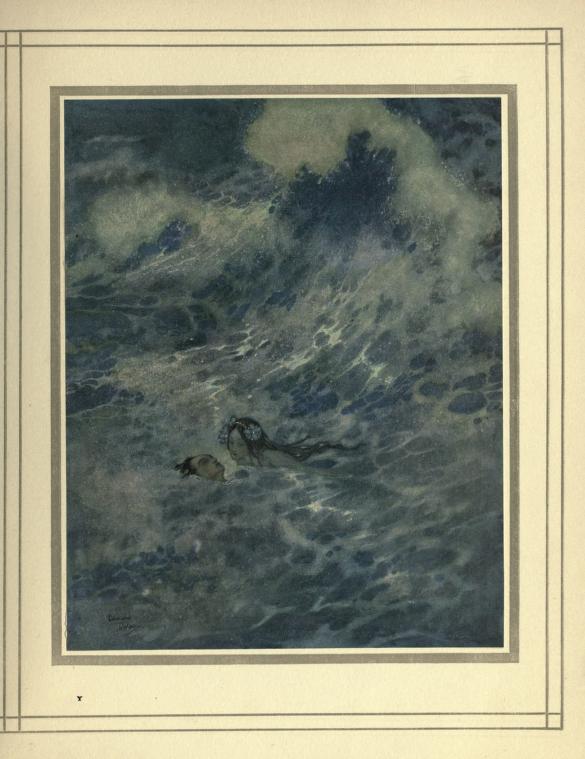
Illustration by Edmund Dulac, taken from Stories from Hans Andersen (1911) on the Internet Archive.

Monday, 12 April 2010

A feast of fairy tales...

There are so many delicious looking fairy tale treats to feast on this week. The new issue of Goblin Fruit, the fantastical poetry zine, is up. And to celebrate their fourth birthday they're giving away lovely icons, like the one to the left, for you to peruse and use (the icons have been created by Deborah J. Brannon, using Oliver Hunter's gorgeous artwork).

The second issue of Enchanted Conversation has also gone live. It's dedicated to Beauty and the Beast and is packed with retellings, reimaginings and reviews of the tale. I can't wait to dig in!

And, if you're still not full up from all that fairy tale goodness, tomorrow night Heston's Fairytale Feast will air on Channel 4 at 9pm. The pudding sounds good: 'the guests make their way through a wooded glade to find a Hansel and Gretel house made entirely of sweets'. But I'm not so sure about some of the other recipes, which, according to the Radio Times, include 'Snow White-style apples, made from blown sugar piped full of boar mousse' and 'chicken testicles done in the style of jelly beans (with a squid-ink coating).'

Hmmm I think I'll stick to reading the tales...

Addition to post: Here's the programme on YouTube if you didn't catch it. Thanks to redridingtweets for the link.

Friday, 9 April 2010

The instructions you'll need...

... if you ever find yourself in a fairy tale:

The book trailer for Neil Gaiman's forthcoming Instructions, beautifully illustrated by Charles Vess (the direct YouTube link is here).

You can also read the text for the poem in the JoMA archives.

Wednesday, 31 March 2010

Too grim for the Grimms...

This is a short film by the wonderful Mucky Puppets based on the tale the Grimms removed from Children's and Household Tales after the first (1812) edition.


I love the film's atmospheric silhouette puppetry, and I'm intrigued by its treatment of this very dark story (the tale can be read online here, along with a commentary by Donald Haase on using it in his teaching here).

Watching the film I couldn't help thinking of this article I read in the Guardian a couple of weeks ago. There's no shying away from the fact that this is a very upsetting subject, but then fairy tales often touch upon subjects that we'd prefer to pretend didn't exist: murder, child abuse, rape, forced marriage, incest, cannibalism, bestiality. In their simple prose, and with their refusal to engage in explicit sensationalism, they have, perhaps, always offered us a way of discussing these subjects. But from the Grimms to the present day there has been a dominant move towards the sanitisation of fairy tales for children. I can understand the desire to protect children but this leaves us with a problem—we can edit our collections of stories, but can we can't edit the world.

Thanks to Richard Mansfield for giving me permission to post the film here.

Tuesday, 30 March 2010

Call for papers - Anti-Tales: The Uses of Disenchantment

(this is an edited version of the call for papers, the full version is now available online here)
“…most intellectual development depends upon new readings of old texts. I am all for putting new wine in old bottles, especially if the pressure of the new wine makes the old bottles explode…” - Angela Carter
An interdisciplinary research forum and subsequent publication of proceedings (Cambridge Scholars Publishing) based around the currently under-researched notion of the 'anti-tale' to be held at the University of Glasgow, Thursday 12th - Friday 13th August 2010. Our confirmed plenary speaker is Dr. Anna Kérchy (Senior Assistant Professor, University of Szeged), and our resident artists will include Robert Powell (Edinburgh College of Art).

The anti-fairy tale has long existed as a shadow of the traditional fairy tale genre. First categorized as the 'antimärchen' in Andre Jolles' seminal Einfache Formen (c.1930), the anti-tale was found to be contemporaneous with even the oldest known examples of fairy tale collections. Rarely an outward opposition to the traditional form itself, the anti-tale takes aspects of the fairy tale genre and re-imagines, subverts, inverts, deconstructs or satirizes elements of them to present an alternate narrative interpretation, outcome or morality. Red Riding Hood may elope with the wolf. Or Bluebeard's wife is not interested in his secret chamber. Snow White's stepmother gives her own account of events and Cinderella does not exactly find the prince charming. The anti-fairy tale takes many forms. Some revisit and deconstruct familiar narratives (as above) or formulate new stories, characters and ever-afters, relying on and subverting familiar archetypes and plot devices.

This project is interdisciplinary in its scope, and our call goes out to a diverse range of disciplines including, but not limited to, scholars and students from: Literature, History of Art, Media/ Film Studies, Psychology, Creative Writing, Music. Our call for new research on 'anti-tales' is intended to provoke creative, imaginative responses, though we are particularly interested in contributions on the following topics:

Once upon a time…
…happily ever after?
The use of the anti-tale and disenchantment in children's and/or adult's literature
Rewritings/ re-readings of the fairy tale
Narrative voice in anti-tales; authorship and authority
Dialogues between the creative and the critical
Morality versus immorality
Feminist interpretations
Decolonizing the fairy tale; culture versus anti-culture?
Context and politics
New perspectives: new writers, new illustrators
Pedagogy (lessons unlearnt)
After 'ever after'?

Please email abstracts of 300 words (max.) for 20 minute papers and C.V. to David Calvin (University of Ulster) and Catriona McAra (University of Glasgow): antitales@googlemail.com by 30th April 2010.

Saturday, 27 March 2010

Islands that are really giants, and the root child from under a tree


I just wanted to link to this gallery of images selected from the work of Kitty Crowther, the Belgian writer and illustrator who won the Astrid Lindgren Memorial Prize this week. The jury said that 'In her world, the door between imagination and reality is wide open. She addresses the reader gently and personally, but with profound effect. In her deeply felt empathy with people in difficulty, she shows ways in which weakness can be turned into strength. '

Judging by these few images there is a definite feel of the fairy tale to her work, which includes 2009 picture book Annie du Lac, which tells the story of Annie and three islands in a lake that turn out to be giants, and enfant racine (2003), which tells the story of Leslie who lives alone in a forest and meets a root child. I'd love to get my hands on these books!

The images in the post are book covers taken from here.

Tuesday, 23 March 2010

Forthcoming events

A couple of fantastic looking events are coming up which I'm too far away to get to, but I wanted to highlight them in case any of you are nearby:

The first is the premiere of Peerifool, a fairy tale film made by the Chagford Filmaking Group (I've written about their brilliant work bringing British fairy tales to the big screen before here). The premiere takes place on Sunday 28th March at Exeter Picturehouse at 12noon and you can buy tickets online.


The tale of Peerifool is available to read online here.

The second is a Marina Warner lecture 'Dark Arts: Magic and Strangers after The Arabian Nights' at Queen Mary University of London on Tuesday 30th March:
'Enchanters in The Arabian Nights are frequently outsiders, infidels who worship fire and command djinns who disobeyed God; in many of the tales, the magicians come from Persia or Africa, or some other elsewhere depicted as faraway and exotic. Marina Warner will explore how these representations combined with a European desire to distance western culture from its tradition of magical thinking, and - in the writings of Voltaire and William Beckford, for example - offered fertile proxies for conveying the enduring fascination - and uses - of enchantment.'
This is Warner's second public lecture as a Distinguished Visiting Professor at the University. The podcast of her first 'Figures in the Carpet: Magic and the 1001 Nights' is available here.

Wednesday, 10 March 2010

Competition for unpublished fairy tales:

The following details are taken from the website for the award and their press release (note that on the website in quite a few places it talks about 'inedited' fairy tales, but I think this is a mistranslation of unpublished, there are also two different closing dates mentioned–the 15th and the 25th–it's probably best to go for the earlier one!)

The Hans Christian Andersen Fairy-tale Award, devoted to children’s literature and unpublished fables, has been taking place in Sestri Levante since 1967. It is an important and prestigious price recognized both in Italy and at international level. In the past editions, the Andersen Award has involved as main characters and jurors, renowned names such as Italo Calvino, Alberto Moravia, Sergio Zavoli, Peppino De Filippo, Mario Soldati and Emanuele Luzzati.

The Award is dedicated to unpublished fables which are divided into four categories differentiated by the authors’ age. These are: Nursery School (between 3 and 5 year old, in groups), children (6 to 10 year old), teenagers (between 11 and 16 year old) and adults (over 16 year old). The Award is also open to foreign authors who can write fairytales in English, French, German and Spanish.

Fairytales can be sent online through the website: www.andersenpremio.it. The rules state that foreign authors can participate in the Andersen Award with an unpublished fable, no longer than three pages, to be sent, no later than March 15 th, 2010.

The winners will be announced at the Andersen Festival (27th to the 30th of May 2010) which will take place in Sestri Levante, a place which Andersen visited and said this about:

“What a fairy-tale evening did I spend in Sestri Levante! The inn was very close to the sea, and a strong undertow lapped against it; clouds in the sky were crimson red and the mountains were sparkling in the brightest colours. The trees themselves were like gigantic fruit baskets, full of rich bunches of grapes.” 1883

The town's Baia delle Favole (Bay of Fables) is named in honour of Andersen.

Tuesday, 2 March 2010

Down rabbit holes...

Alice's Adventures in Wonderland is not really a fairy tale, but, like Peter Pan and the Oz books, it is often considered to be one of what L. Frank Baum called the 'newer "wonder tales". But before I get properly started I have a confession to make. Alice is not one of my favourite tales, in fact far from it, but as there's no escaping Alice this week I wanted to collect together some of the many great Alice links I've come across.

My problem with Alice is the ending. Reading a beautiful pop-up version with my sons over the last few days I've been reminded just how much I loved the stories as a child—until I got to the end. And Lewis Caroll does it to us not once but twice. In both stories we reach the dreaded waking. Why create such a wonderful reality only to destroy it with 'Wake up, Alice dear!' .... 'Why, what a long sleep you've had!'

No! Of course as an adult re-reading the books I can see all the metaphors and symbols. I can admit that we are told Alice is feeling very 'sleepy and stupid' and falling down the rabbit hole could be a metaphor for falling asleep... but the details: the sides of the well 'filled with cupboards and bookshelves...maps and pictures hung upon pegs'. As a child I read the story literally and I still want this to be an actual doorway into another world. Just as the back of the wardrobe was in The Lion the Witch and the Wardrobe. These magical doorways were the most exciting thing to me about stories when I first began reading. There was the picture of the Dawntreader too, and when I was seven I had a teacher called Miss Jackson who told us wonderful tales of the Tockholes Treacle Miners. Tockholes was a village near where we lived and the doorways into the miners' underground world were to be found in the landscape all around us (and I've looked out for them ever since). In Through the Looking-Glass there is another magical entrance: the glass 'was beginning to melt away, just like a bright silvery mist' so that Alice could step through.

I just wish Caroll had provided a satisfying exit route from Wonderland too, rather than cheating us with it all having been a dream. But despite this, I await the Tim Burton film, which reimagines the Alice stories, with glee. And in the meantime I'm enjoying revisiting Alice with my sons—the eldest keeps standing on the book, trying to get down the rabbit hole...

Digitised manuscripts and illustrations:

Alice's Adventures Under Ground—the original manuscript as written and illustrated by Caroll, on the British Library site
Alice's Adventures in Wonderland (1866), as illustrated by John Tenniel
Alice's Adventures in Wonderland (1907), as illustrated by Arthur Rackham
Alice's Adventures in Wonderland and Through the Looking-Glass and what Alice Found There (1911)
Salvador Dali's illustrations (1969)
Illustrators of Alice on the web

Early films (available to watch online):
Alice in Wonderland (1903) silent film by Cecil Hepworth
Alice in Wonderland (1915) silent film by W.W.Young

Interviews:
Tim Burton interview on Radio 4—a brilliant interview, thanks to Faye for the link.
Tim Burton and Johnny Depp on Friday Night with Jonathan Ross—a slightly more awkward interview, and as much as I love Johnny Depp I wish Ross had paid more attention to Tim Burton.
Interview with Mia Wasikowska, the new Alice, in The Times

Articles:

There's something about Alice, AS Byatt in The Guardian—an engaging article which takes in a lot of other British children's classics but says less than I would have expected about Alice.
Innocence, obsession and the making of Alice in Wonderland, Peter Ackroyd in The Times—an interesting article about the history of the story and Dodgson himself.

Additional interesting links:
A-Z of Alice in Wonderland — eclectic list of all things Alice from The Independent.
Info about Alice in Sunderland — a fantastic looking Graphic Novel, thanks to Andy Hedgecock for the recommendation.


Illustration by Arthur Rackham 'At this the whole pack rose up into the air, and came flying down upon her' P158

Tuesday, 23 February 2010

New additions and call for submissions

Firstly, I want to welcome the newly expanded New Fairy Tales team:

Associate Editor for Fiction: Andy Hedgecock
Associate Editor for Poetry: Anna McKerrow
Art Director: Faye Durston

Andy, a freelance writer and researcher, is also the Co-Fiction Editor for leading UK science fiction and fantasy magazine Interzone. Anna is a poet, whose first collection The Fast Heat of Beauty came out in 2008. She's also recently been working on a writing project called Bookbite. Faye is a writer and children's illustrator whose first book is due out from Macmillan in September. She has also done some lovely work for the magazine before (the illustration above is one of hers as is my blog banner).

I'm incredibly excited about working with them all, and we're now looking for some fantastic new fairy tales for Issue 5.

The call for submissions is below:

New Fairy Tales call for submissions
www.newfairytales.co.uk

We are currently seeking submissions for our fifth issue. We are looking for new fairy tales in short story format (max 3000 words), and in other formats such as poetry, flash fiction and comic strip.

We welcome works inspired by a love of traditional tales but we are not looking for retellings or reimaginings of existing tales. Show us what you think a new fairy tale can be.

For full submission guidelines please visit our website: www.newfairytales.co.uk/pages/submissions.html

All submissions should be sent to the editors at newfairytales@googlemail.com

The deadline for submissions to our fifth issue is 20th April 2010.

Saturday, 20 February 2010

10 rules

Not strictly fairy tale related, but today's Guardian contains 10 rules for writing fiction by lots of great writers. I wanted to link to it here on the basis that a. some of you may write and so find this interesting, and b. some of the writers who've contributed have done wonderful things with fairy tales.

Here's a little taste of the rules by the fairy tale writers:

Margaret Atwood: 'Don't sit down in the middle of the woods. If you're lost in the plot or blocked, retrace your steps to where you went wrong. Then take the other road. And/or change the person. Change the tense. Change the opening page.'

Neil Gaiman: 'The main rule of writing is that if you do it with enough assurance and confidence, you're allowed to do whatever you like. (That may be a rule for life as well as for writing. But it's definitely true for writing.) So write your story as it needs to be written. Write it ­honestly, and tell it as best you can. I'm not sure that there are any other rules. Not ones that matter.'

Jeanette Winterson: 'Turn up for work. Discipline allows creative freedom. No discipline equals no freedom.'

and I had to end on Philip Pullman who contributed this: 'My main rule is to say no to things like this, which tempt me away from my proper work.'

There are lots of other fantastic writers featured too (including Michael Morpurgo, Michael Moorcock, Annie Proulx, Hilary Mantel—I could go on) so it's well worth a read. The article is available online in two parts:
Part 1
Part 2

Wednesday, 17 February 2010

Undine and Ondine

In The Fantastic Imagination, George Macdonald, one of my favourite fairy tale writers, said:
'Were I asked, what is a fairytale? I should reply, Read Undine: that is a fairytale; then read this and that as well, and you will see what is a fairytale. Were I further begged to describe the fairytale, or define what it is, I would make answer, that I should as soon think of describing the abstract human face, or stating what must go to constitute a human being. A fairytale is just a fairytale, as a face is just a face; and of all fairytales I know, I think Undine the most beautiful.'
Undine is one of the inspirations behind Neil Jordan's forthcoming film Ondine. Gypsy, at Once Upon a Blog, wrote a great post about the film last week, but I'm so excited about it I wanted to share the trailer here too:


Also, there is a beautiful digitised copy of Undine, illustrated by Arthur Rackham, available to read online here.

Wednesday, 10 February 2010

Sussex Centre for Folklore, Fairy Tales and Fantasy

(I've just found out about this and had to post something straight away!) The Sussex Centre for Folklore, Fairy Tales and Fantasy is a new and incredibly exciting project which intends to 'focus on the importance of fairy tales as a creative force both in literature and culture.'

Here's some information from their website:

The Centre will provide a forum where writers and scholars from various disciplines can discuss folk narratives, fairy tales and fantasy works, both as independent ‘genres’ (the literary fantastic, for example, may not always have obvious folk- or fairy-tale motifs), and also in terms of the resonances and dissonances between them, and other cultural forms.

Although the scope of the project is geographically and culturally inclusive, the founding impulse for the Centre is related to the specific locale of Sussex and its surrounding region. This area is rich in examples of all three kinds of narrative, ranging from folk narratives of various kinds, through literary fairy tales written in, as well as about, Sussex (for example, by George MacDonald and Eleanor Farjeon), to major works of fantasy and myth by Sussex residents such as MacDonald (Phantastes), David Lindsay (A Voyage to Arcturus), Mervyn Peake (Gormenghast) and Neil Gaiman (Stardust).

While the project is situated in Sussex, its planned scope is not only national but also international, bringing together writers and scholars, as well as publishing and curating scholarly resources, from around the globe.

The centre is being directed by Bill Gray, Professor of Literary History and Hermeneutics at the University of Chichester, and the advisory board includes a fantastic number of the most important fairy tale scholars working in the world today (including Cristina Bacchilega, Marina Warner, and Jack Zipes).

The project is going to create an online, multilingual, multi-authored, annotated bibliographic index consisting of links to primary sources of folktales, fairy tales and fantasy works available in the public domain, as well as to secondary sources for scholarly discussion on these subjects.

There will also be events, including a symposium to mark the centenary of author and illustrator Mervyn Peake (1911-1968) in 2011, and an international conference on ‘Folklore, Fairy Tales and the Fantastic Imagination’ in 2012, to celebrate the bicentenary of the publication of the Grimm Brothers’ Children’s and Household Tales.

Planned publications include an online newsletter and journal, and there is a Folktales mailing list, which is going to be used to facilitate interdisciplinary discussion of folktales, fairy tales and fantasy literature. Contributions can include research enquiries as well information about relevant publications and events.

So although the centre is physically based in Sussex it will bring benefits to fairy tale lovers worldwide. Make sure you visit their site to find out more.

Friday, 5 February 2010

Profile: The Big Bad Wolf

Name: In the old tales he is most often referred to simply as 'the wolf'. It was during the recording of Disney's famous 1933 song (which you can listen to further down) that he acquired the 'Big Bad'. He was originally going to be called 'The Big Old Wolf' but reportedly Walt decided 'The Big Bad Wolf' scanned better.

Age: Impossible to figure out—but here's what we do know: Fenir, one of the first bad wolves, can be found in Norse mythology (he's mentioned in the Poetic Edda which was compiled from oral sources in the 13th century). The wolf and werewolf are thought to have been popular figures in oral folk tales for centuries—The Grandmother, which was collected in 1870, is representative of this tradition. The wolf, as we are perhaps most familiar with him, appears in three distinct fairy tales in the European literary tradition:

Little Red Riding Hood: the first literary version, by Charles Perrault, was published in 1697. In this version the wolf gets exactly what he wants and we're warned of wolves 'who are charming, quiet, polite, unassuming, complacent, and sweet, who pursue young women at home and in the street' (or as Grandmother so succinctly puts it in the film The Company of Wolves 'The worst kind of wolf is hairy on the inside'). The Grimms included their version of the tale, Little Red Cap, in every edition of their Children's and Household Tales; you can read the 1812 version, or the final 1857 version online. It was the Grimms who introduced the woodsman and the nasty ending for the wolf.

The Wolf and the Seven Young Kids: first published by the Grimms in Children's and Household Tales in 1812, the tale includes a very similar fate for the wolf.

The Story of the Three Little Pigs: first collected by James Orchard Haliwell in The Nursery Rhymes of England in its first edition of 1842. This was the source for Joseph Jacob's more famous 1890 version.

Location: Wolf and werewolf tales were common throughout Europe, particularly in France, but not so much here in Britain where unfortunately we'd managed to exterminate wolves by the 17th century—we have lots of Last Wolf tales instead.

Relationship Status: You might think a wolf who went round either scoffing small pigs, baby goats, or young girls and/or their Grandmothers might find it hard to get a date—but that's not always the case—whether it's Red herself that takes a fancy to him, as in Angela Carter's 'The Company of Wolves' (from The Bloody Chamber) and Carol Ann Duffy's 'Little Red-Cap' (from The World's Wife); or Grandma, as in the original ending to Tex Avery's 1943 cartoon Red Hot Riding Hood (which was cut because it was thought to be too close to bestiality), and in this 1931 cartoon:

taken from the Internet Archive

Who's afraid of the Big Bad Wolf?

taken from the Internet Archive
As we've already seen not everybody, and although the wolf in the older tales is always bad there are a lot of reformed versions out there, from Bigby (sherrif, and son of the North Wind—from whom he inherited his Huff 'n Puff) in the unbelievably good Fables series; to the cross-dressing, rather lazy wolf in the Shrek films.

Some other places you'll find him lurking online:

An 1866 verse version of Little Red Riding Hood by Tom Hood, which includes the illustrations by Gustave Doré.

Little Red Riding Hood—A 1921 version with lovely illustrations by Jennie Harbour.

Roald Dahl's wonderful Little Red Riding Hood and the Wolf

An illustrated copy of The Story of the Three Little Pigs, from 1904.

A Wolf's Lament, by M. Lynn Johnson— a great story that featured in Issue 8 of Cabinet Des Fées

The wolf in myths, legends and stories at Wolf Country.

A collection of Werewolf Legends from Germany, translated by D.L. Ashliman.

The Bad Wolf site, created by the BBC to accompany the 2005 series of Doctor Who throughout which the ominous sounding 'Bad Wolf' message was scattered.

Any more sitings of the wolf online? Feel free to add links using the comments function below.


The wolf image at the top of the post is a detail from an illustration by Gustave Doré.