
When I was little I could see two hills from my bedroom window and I was convinced that the White Witch from the
Narnia books lived between them (I also spent a lot of time trying to get through the back of wardrobes). I wasn't scared of her - I wanted to find a way to visit her. There's something about cold queens, ice queens that has always fascinated me. When Edmund first meets the White Witch, who has imposed eternal winter (without Christmas) on Narnia, we are told 'Her face was white - not merely pale, but white like snow or paper or icing-sugar, except for her very red mouth. It was a beautiful face in other respects, but proud and cold and stern.'
Her entrance, in a sleigh, is so similar to Hans Christian Andersen's
'The Snow Queen' (1845) that it seems impossible that Lewis was not influenced by the earlier story. Though unlike the White Witch the Snow Queen is actually made of ice:
'This snow-flake grew larger and larger, till at last it became the figure of a woman, dressed in garments of white gauze, which looked like millions of starry snow-flakes linked together. She was fair and beautiful, but made of ice—shining and glittering ice. Still she was alive and her eyes sparkled like bright stars, but there was neither peace nor rest in their glance.'
Andersen's Snow Queen sits in her palace on a frozen lake which she calls 'The Mirror of Reason' and so, cold and barren, she embodies Andersen's ideas about reason and science. But he also created another ice woman -
'The Ice Maiden' (1861) - who he uses for the opposite role - she represents the forces of nature and is the enemy of reason, although she also has to have what she wants...
'Ice Maiden—the queen of the glaciers. It is she whose mighty power can crush the traveller to death, and arrest the flowing river in its course. She is also a child of the air, and with the swiftness of the chamois she can reach the snow-covered mountain tops, where the boldest mountaineer has to cut footsteps in the ice to ascend. She will sail on a frail pine-twig over the raging torrents beneath, and spring lightly from one iceberg to another, with her long, snow-white hair flowing around her, and her dark-green robe glittering like the waters of the deep Swiss lakes. “Mine is the power to seize and crush,” she cried. “Once a beautiful boy was stolen from me by man,—a boy whom I had kissed, but had not kissed to death. He is again among mankind, and tends the goats on the mountains. He is always climbing higher and higher, far away from all others, but not from me. He is mine'
'The Ice Maiden' was inspired by the death of Andersen's father, which he talks about in his autobiography
The True Story of my Life:
"He is dead," said my mother, addressing it; "thou needest not call him. The ice maiden has fetched him."
I understood what she meant. I recollected that, in the winter before, when our window panes were frozen, my father pointed to them and showed us a figure as that of a maiden with outstretched arms. "She is come to fetch me," said he, in jest. And now, when he lay dead on the bed, my mother remembered this, and it occupied my thoughts also.'

Snegurochka, a woman made of snow, rather than ice, appears in Russian fairy tales; in one variant, '
The Snow Maiden', she is fashioned from snow by an old childless couple, and in the Russian festive tradition Snegurochka is the granddaughter and assistant of
Ded Moroz, Grandfather Frost, the Russian equivalent of Father Christmas (you'll find lots of lovely illustrations of her in a post on
A Polar Bear's Tale). In contrast to the cold women I've mentioned above the Snow Maiden is kindlier, and made to suffer by others, and hers is not a happy ending because snow melts too easily.
Ice is hard, sharp and clear; it offers an illusion of permanence - it reminds us of glass. It is this last similarity that
A.S. Byatt has played on to wonderful effect in the fairy tale 'Cold', from her collection
Elementals. In the tale, Fiammarosa, a princess descended from an icewoman, is docile and doughy when kept in the warmth, but she is enlivened by the cold, and once she discovers this she escapes the palace at night to dance in the snow...
'And one night, as she moved, she found that her whole body was encased in a transparent, crackling skin of ice, that broke into spiderweb-fine veined sheets as she danced, and then reformed. The sensation of this double skin was delicious. She had frozen eyelashes and saw the world through an ice-lens'
Yet she falls in love with Sasan, a desert prince, wooed by his amazingly intricate glass sculptures. She sees the resemblance between glass and ice but she knows nothing of the dangerous heat that glass must be formed in.
Byatt
has said the tale is about her relationship to writing, and in her essay 'Ice, Snow, Glass' in
Mirror, Mirror on the Wall she says that even as a girl she knew that 'there was something secretly good, illicitly desirable, about the ice hills and glass barriers.' She later says:
'The frozen stony women became my images of choosing the perfection of the work, rejecting (so it seemed to me then, though I have done my best to keep my apple and swallow it) the imposed biological cycle, blood, kiss, roses, birth, death and the hungry generations.'
Fiammarosa also finds a compromise, although this has to be within the confines of a chilled palace in the heart of a mountain, at the edge of the desert kingdom:
'And if Fiammarosa was sometimes lonely in her glass palace, and sometimes wished both that Sasan would come more often, and that she could roam amongst fjords and ice-fells, this was not unusual, for no one has everything they desire. But she was resourceful and hopeful, and made a study of the vegetation of the Sasanian snow-line, and a further study of which plants could thrive in mountain air under glass windows, and corresponded - at long intervals - with authorities all over the world on these matters.'
It seems there is a choice for ice queens, who think, as Fiammarosa does at first, that there is 'more life in coldness. In solitude. Inside a crackling skin of protective ice'. They can stay out in the cold, or, take the risk of melting a little, but either way happiness comes and goes in flurries, just like the snow.
A few other icy paths to travel...
The Snow Queen in a beautiful digitised copy of
Stories from Hans Andersen, illustrated by Edmund Dulac.
A lovely digitised copy of
The Ice Maiden.
The Snow Queen, a poem by Jeannine Hall Gailey from the
JOMA archives.
This week is Snow Queen week on the
SurLaLune blog and Heidi Anne Heiner will be featuring several of the adaptations of the tale.
Thank you to
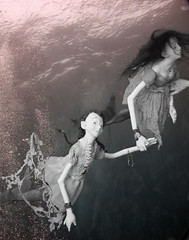
Graham Dean and Louise Dean for the fantastic photographs!

 Firstly, I want to welcome the newly expanded New Fairy Tales team:








 Posts
Posts


