Thank you for visiting the cupboard. I now have a new blog here.


Sunday, 9 May 2010

Once upon a time...


I was going to try and write a short fairy tale as some kind of justification for including this post on what is essentially a topic blog. But fairy tales don’t deal in democracy. In the UK it doesn't always feel like we do either.

During my lifetime the UK has been failed, first by a Tory government, then by Blair and Browns’ false Labour. Our politicians have helped instigate an illegal war and facilitated economic disaster.

Our parliament is full of wolves. In Perrault’s version of Little Red Riding Hood the wolf eats the girl, she doesn't escape; in the Grimms’ version she must be rescued by the Huntsman. I prefer the version where she sorts things out for herself.

We don’t know what the ending of the current election tale will be but I’m one of the many people who feels, as not all votes count, we haven’t been given a chance to sort things out for ourselves. If you’re a British citizen consider signing this petition for electoral reform and joining the forthcoming demonstrations. In life there can’t be a happily ever after but there must be better than this.


Some additional links:
The BBC's Q&A: Calls to change the UK election voting system
The Electoral Reform Society
Fair votes now!, Comment at The Guardian
Kay Burley bullies a protester - an example of what passes for journalism in the Murdoch empire
Chris Riddell's 'fairy in search of electoral reform'


The image in this post is from ruSSeLL hiGG's Flickr stream and is under a CC license, it was photographed in East London the day after the election.

Tuesday, 4 May 2010

Call for submissions - Enchanted Conversation

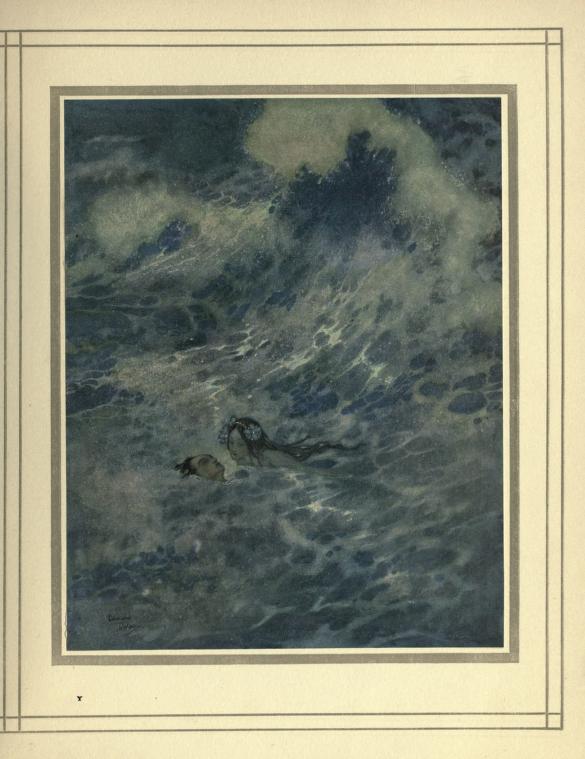
Enchanted Conversation, is an online fairy tale magazine in Blogger format. They are currently publishing four issues a year, each takes the theme of a traditional tale as its starting point. Submissions are now open for 'The Little Mermaid' issue. They are also happy to look at submissions inspired by other watery tales such as Undine and The Nixy. The deadline is the 15th May and full submission guidelines are available here.

Also not to be missed are the two contests they're running alongside their current 'Beauty and the Beast' issue. One is a writing contest, and for the other you need only join in the conversation and comment on a piece in the issue to be entered.

Illustration by Edmund Dulac, taken from Stories from Hans Andersen (1911) on the Internet Archive.

Monday, 12 April 2010

A feast of fairy tales...

There are so many delicious looking fairy tale treats to feast on this week. The new issue of Goblin Fruit, the fantastical poetry zine, is up. And to celebrate their fourth birthday they're giving away lovely icons, like the one to the left, for you to peruse and use (the icons have been created by Deborah J. Brannon, using Oliver Hunter's gorgeous artwork).

The second issue of Enchanted Conversation has also gone live. It's dedicated to Beauty and the Beast and is packed with retellings, reimaginings and reviews of the tale. I can't wait to dig in!

And, if you're still not full up from all that fairy tale goodness, tomorrow night Heston's Fairytale Feast will air on Channel 4 at 9pm. The pudding sounds good: 'the guests make their way through a wooded glade to find a Hansel and Gretel house made entirely of sweets'. But I'm not so sure about some of the other recipes, which, according to the Radio Times, include 'Snow White-style apples, made from blown sugar piped full of boar mousse' and 'chicken testicles done in the style of jelly beans (with a squid-ink coating).'

Hmmm I think I'll stick to reading the tales...

Addition to post: Here's the programme on YouTube if you didn't catch it. Thanks to redridingtweets for the link.

Friday, 9 April 2010

The instructions you'll need...

... if you ever find yourself in a fairy tale:

The book trailer for Neil Gaiman's forthcoming Instructions, beautifully illustrated by Charles Vess (the direct YouTube link is here).

You can also read the text for the poem in the JoMA archives.

Wednesday, 31 March 2010

Too grim for the Grimms...

This is a short film by the wonderful Mucky Puppets based on the tale the Grimms removed from Children's and Household Tales after the first (1812) edition.


I love the film's atmospheric silhouette puppetry, and I'm intrigued by its treatment of this very dark story (the tale can be read online here, along with a commentary by Donald Haase on using it in his teaching here).

Watching the film I couldn't help thinking of this article I read in the Guardian a couple of weeks ago. There's no shying away from the fact that this is a very upsetting subject, but then fairy tales often touch upon subjects that we'd prefer to pretend didn't exist: murder, child abuse, rape, forced marriage, incest, cannibalism, bestiality. In their simple prose, and with their refusal to engage in explicit sensationalism, they have, perhaps, always offered us a way of discussing these subjects. But from the Grimms to the present day there has been a dominant move towards the sanitisation of fairy tales for children. I can understand the desire to protect children but this leaves us with a problem—we can edit our collections of stories, but can we can't edit the world.

Thanks to Richard Mansfield for giving me permission to post the film here.

Tuesday, 30 March 2010

Call for papers - Anti-Tales: The Uses of Disenchantment

(this is an edited version of the call for papers, the full version is now available online here)
“…most intellectual development depends upon new readings of old texts. I am all for putting new wine in old bottles, especially if the pressure of the new wine makes the old bottles explode…” - Angela Carter
An interdisciplinary research forum and subsequent publication of proceedings (Cambridge Scholars Publishing) based around the currently under-researched notion of the 'anti-tale' to be held at the University of Glasgow, Thursday 12th - Friday 13th August 2010. Our confirmed plenary speaker is Dr. Anna Kérchy (Senior Assistant Professor, University of Szeged), and our resident artists will include Robert Powell (Edinburgh College of Art).

The anti-fairy tale has long existed as a shadow of the traditional fairy tale genre. First categorized as the 'antimärchen' in Andre Jolles' seminal Einfache Formen (c.1930), the anti-tale was found to be contemporaneous with even the oldest known examples of fairy tale collections. Rarely an outward opposition to the traditional form itself, the anti-tale takes aspects of the fairy tale genre and re-imagines, subverts, inverts, deconstructs or satirizes elements of them to present an alternate narrative interpretation, outcome or morality. Red Riding Hood may elope with the wolf. Or Bluebeard's wife is not interested in his secret chamber. Snow White's stepmother gives her own account of events and Cinderella does not exactly find the prince charming. The anti-fairy tale takes many forms. Some revisit and deconstruct familiar narratives (as above) or formulate new stories, characters and ever-afters, relying on and subverting familiar archetypes and plot devices.

This project is interdisciplinary in its scope, and our call goes out to a diverse range of disciplines including, but not limited to, scholars and students from: Literature, History of Art, Media/ Film Studies, Psychology, Creative Writing, Music. Our call for new research on 'anti-tales' is intended to provoke creative, imaginative responses, though we are particularly interested in contributions on the following topics:

Once upon a time…
…happily ever after?
The use of the anti-tale and disenchantment in children's and/or adult's literature
Rewritings/ re-readings of the fairy tale
Narrative voice in anti-tales; authorship and authority
Dialogues between the creative and the critical
Morality versus immorality
Feminist interpretations
Decolonizing the fairy tale; culture versus anti-culture?
Context and politics
New perspectives: new writers, new illustrators
Pedagogy (lessons unlearnt)
After 'ever after'?

Please email abstracts of 300 words (max.) for 20 minute papers and C.V. to David Calvin (University of Ulster) and Catriona McAra (University of Glasgow): antitales@googlemail.com by 30th April 2010.

Saturday, 27 March 2010

Islands that are really giants, and the root child from under a tree


I just wanted to link to this gallery of images selected from the work of Kitty Crowther, the Belgian writer and illustrator who won the Astrid Lindgren Memorial Prize this week. The jury said that 'In her world, the door between imagination and reality is wide open. She addresses the reader gently and personally, but with profound effect. In her deeply felt empathy with people in difficulty, she shows ways in which weakness can be turned into strength. '

Judging by these few images there is a definite feel of the fairy tale to her work, which includes 2009 picture book Annie du Lac, which tells the story of Annie and three islands in a lake that turn out to be giants, and enfant racine (2003), which tells the story of Leslie who lives alone in a forest and meets a root child. I'd love to get my hands on these books!

The images in the post are book covers taken from here.

Tuesday, 23 March 2010

Forthcoming events

A couple of fantastic looking events are coming up which I'm too far away to get to, but I wanted to highlight them in case any of you are nearby:

The first is the premiere of Peerifool, a fairy tale film made by the Chagford Filmaking Group (I've written about their brilliant work bringing British fairy tales to the big screen before here). The premiere takes place on Sunday 28th March at Exeter Picturehouse at 12noon and you can buy tickets online.


The tale of Peerifool is available to read online here.

The second is a Marina Warner lecture 'Dark Arts: Magic and Strangers after The Arabian Nights' at Queen Mary University of London on Tuesday 30th March:
'Enchanters in The Arabian Nights are frequently outsiders, infidels who worship fire and command djinns who disobeyed God; in many of the tales, the magicians come from Persia or Africa, or some other elsewhere depicted as faraway and exotic. Marina Warner will explore how these representations combined with a European desire to distance western culture from its tradition of magical thinking, and - in the writings of Voltaire and William Beckford, for example - offered fertile proxies for conveying the enduring fascination - and uses - of enchantment.'
This is Warner's second public lecture as a Distinguished Visiting Professor at the University. The podcast of her first 'Figures in the Carpet: Magic and the 1001 Nights' is available here.

Wednesday, 10 March 2010

Competition for unpublished fairy tales:

The following details are taken from the website for the award and their press release (note that on the website in quite a few places it talks about 'inedited' fairy tales, but I think this is a mistranslation of unpublished, there are also two different closing dates mentioned–the 15th and the 25th–it's probably best to go for the earlier one!)

The Hans Christian Andersen Fairy-tale Award, devoted to children’s literature and unpublished fables, has been taking place in Sestri Levante since 1967. It is an important and prestigious price recognized both in Italy and at international level. In the past editions, the Andersen Award has involved as main characters and jurors, renowned names such as Italo Calvino, Alberto Moravia, Sergio Zavoli, Peppino De Filippo, Mario Soldati and Emanuele Luzzati.

The Award is dedicated to unpublished fables which are divided into four categories differentiated by the authors’ age. These are: Nursery School (between 3 and 5 year old, in groups), children (6 to 10 year old), teenagers (between 11 and 16 year old) and adults (over 16 year old). The Award is also open to foreign authors who can write fairytales in English, French, German and Spanish.

Fairytales can be sent online through the website: www.andersenpremio.it. The rules state that foreign authors can participate in the Andersen Award with an unpublished fable, no longer than three pages, to be sent, no later than March 15 th, 2010.

The winners will be announced at the Andersen Festival (27th to the 30th of May 2010) which will take place in Sestri Levante, a place which Andersen visited and said this about:

“What a fairy-tale evening did I spend in Sestri Levante! The inn was very close to the sea, and a strong undertow lapped against it; clouds in the sky were crimson red and the mountains were sparkling in the brightest colours. The trees themselves were like gigantic fruit baskets, full of rich bunches of grapes.” 1883

The town's Baia delle Favole (Bay of Fables) is named in honour of Andersen.

Tuesday, 2 March 2010

Down rabbit holes...

Alice's Adventures in Wonderland is not really a fairy tale, but, like Peter Pan and the Oz books, it is often considered to be one of what L. Frank Baum called the 'newer "wonder tales". But before I get properly started I have a confession to make. Alice is not one of my favourite tales, in fact far from it, but as there's no escaping Alice this week I wanted to collect together some of the many great Alice links I've come across.

My problem with Alice is the ending. Reading a beautiful pop-up version with my sons over the last few days I've been reminded just how much I loved the stories as a child—until I got to the end. And Lewis Caroll does it to us not once but twice. In both stories we reach the dreaded waking. Why create such a wonderful reality only to destroy it with 'Wake up, Alice dear!' .... 'Why, what a long sleep you've had!'

No! Of course as an adult re-reading the books I can see all the metaphors and symbols. I can admit that we are told Alice is feeling very 'sleepy and stupid' and falling down the rabbit hole could be a metaphor for falling asleep... but the details: the sides of the well 'filled with cupboards and bookshelves...maps and pictures hung upon pegs'. As a child I read the story literally and I still want this to be an actual doorway into another world. Just as the back of the wardrobe was in The Lion the Witch and the Wardrobe. These magical doorways were the most exciting thing to me about stories when I first began reading. There was the picture of the Dawntreader too, and when I was seven I had a teacher called Miss Jackson who told us wonderful tales of the Tockholes Treacle Miners. Tockholes was a village near where we lived and the doorways into the miners' underground world were to be found in the landscape all around us (and I've looked out for them ever since). In Through the Looking-Glass there is another magical entrance: the glass 'was beginning to melt away, just like a bright silvery mist' so that Alice could step through.

I just wish Caroll had provided a satisfying exit route from Wonderland too, rather than cheating us with it all having been a dream. But despite this, I await the Tim Burton film, which reimagines the Alice stories, with glee. And in the meantime I'm enjoying revisiting Alice with my sons—the eldest keeps standing on the book, trying to get down the rabbit hole...

Digitised manuscripts and illustrations:

Alice's Adventures Under Ground—the original manuscript as written and illustrated by Caroll, on the British Library site
Alice's Adventures in Wonderland (1866), as illustrated by John Tenniel
Alice's Adventures in Wonderland (1907), as illustrated by Arthur Rackham
Alice's Adventures in Wonderland and Through the Looking-Glass and what Alice Found There (1911)
Salvador Dali's illustrations (1969)
Illustrators of Alice on the web

Early films (available to watch online):
Alice in Wonderland (1903) silent film by Cecil Hepworth
Alice in Wonderland (1915) silent film by W.W.Young

Interviews:
Tim Burton interview on Radio 4—a brilliant interview, thanks to Faye for the link.
Tim Burton and Johnny Depp on Friday Night with Jonathan Ross—a slightly more awkward interview, and as much as I love Johnny Depp I wish Ross had paid more attention to Tim Burton.
Interview with Mia Wasikowska, the new Alice, in The Times

Articles:

There's something about Alice, AS Byatt in The Guardian—an engaging article which takes in a lot of other British children's classics but says less than I would have expected about Alice.
Innocence, obsession and the making of Alice in Wonderland, Peter Ackroyd in The Times—an interesting article about the history of the story and Dodgson himself.

Additional interesting links:
A-Z of Alice in Wonderland — eclectic list of all things Alice from The Independent.
Info about Alice in Sunderland — a fantastic looking Graphic Novel, thanks to Andy Hedgecock for the recommendation.


Illustration by Arthur Rackham 'At this the whole pack rose up into the air, and came flying down upon her' P158

Tuesday, 23 February 2010

New additions and call for submissions

Firstly, I want to welcome the newly expanded New Fairy Tales team:

Associate Editor for Fiction: Andy Hedgecock
Associate Editor for Poetry: Anna McKerrow
Art Director: Faye Durston

Andy, a freelance writer and researcher, is also the Co-Fiction Editor for leading UK science fiction and fantasy magazine Interzone. Anna is a poet, whose first collection The Fast Heat of Beauty came out in 2008. She's also recently been working on a writing project called Bookbite. Faye is a writer and children's illustrator whose first book is due out from Macmillan in September. She has also done some lovely work for the magazine before (the illustration above is one of hers as is my blog banner).

I'm incredibly excited about working with them all, and we're now looking for some fantastic new fairy tales for Issue 5.

The call for submissions is below:

New Fairy Tales call for submissions
www.newfairytales.co.uk

We are currently seeking submissions for our fifth issue. We are looking for new fairy tales in short story format (max 3000 words), and in other formats such as poetry, flash fiction and comic strip.

We welcome works inspired by a love of traditional tales but we are not looking for retellings or reimaginings of existing tales. Show us what you think a new fairy tale can be.

For full submission guidelines please visit our website: www.newfairytales.co.uk/pages/submissions.html

All submissions should be sent to the editors at newfairytales@googlemail.com

The deadline for submissions to our fifth issue is 20th April 2010.

Saturday, 20 February 2010

10 rules

Not strictly fairy tale related, but today's Guardian contains 10 rules for writing fiction by lots of great writers. I wanted to link to it here on the basis that a. some of you may write and so find this interesting, and b. some of the writers who've contributed have done wonderful things with fairy tales.

Here's a little taste of the rules by the fairy tale writers:

Margaret Atwood: 'Don't sit down in the middle of the woods. If you're lost in the plot or blocked, retrace your steps to where you went wrong. Then take the other road. And/or change the person. Change the tense. Change the opening page.'

Neil Gaiman: 'The main rule of writing is that if you do it with enough assurance and confidence, you're allowed to do whatever you like. (That may be a rule for life as well as for writing. But it's definitely true for writing.) So write your story as it needs to be written. Write it ­honestly, and tell it as best you can. I'm not sure that there are any other rules. Not ones that matter.'

Jeanette Winterson: 'Turn up for work. Discipline allows creative freedom. No discipline equals no freedom.'

and I had to end on Philip Pullman who contributed this: 'My main rule is to say no to things like this, which tempt me away from my proper work.'

There are lots of other fantastic writers featured too (including Michael Morpurgo, Michael Moorcock, Annie Proulx, Hilary Mantel—I could go on) so it's well worth a read. The article is available online in two parts:
Part 1
Part 2

Wednesday, 17 February 2010

Undine and Ondine

In The Fantastic Imagination, George Macdonald, one of my favourite fairy tale writers, said:
'Were I asked, what is a fairytale? I should reply, Read Undine: that is a fairytale; then read this and that as well, and you will see what is a fairytale. Were I further begged to describe the fairytale, or define what it is, I would make answer, that I should as soon think of describing the abstract human face, or stating what must go to constitute a human being. A fairytale is just a fairytale, as a face is just a face; and of all fairytales I know, I think Undine the most beautiful.'
Undine is one of the inspirations behind Neil Jordan's forthcoming film Ondine. Gypsy, at Once Upon a Blog, wrote a great post about the film last week, but I'm so excited about it I wanted to share the trailer here too:


Also, there is a beautiful digitised copy of Undine, illustrated by Arthur Rackham, available to read online here.

Wednesday, 10 February 2010

Sussex Centre for Folklore, Fairy Tales and Fantasy

(I've just found out about this and had to post something straight away!) The Sussex Centre for Folklore, Fairy Tales and Fantasy is a new and incredibly exciting project which intends to 'focus on the importance of fairy tales as a creative force both in literature and culture.'

Here's some information from their website:

The Centre will provide a forum where writers and scholars from various disciplines can discuss folk narratives, fairy tales and fantasy works, both as independent ‘genres’ (the literary fantastic, for example, may not always have obvious folk- or fairy-tale motifs), and also in terms of the resonances and dissonances between them, and other cultural forms.

Although the scope of the project is geographically and culturally inclusive, the founding impulse for the Centre is related to the specific locale of Sussex and its surrounding region. This area is rich in examples of all three kinds of narrative, ranging from folk narratives of various kinds, through literary fairy tales written in, as well as about, Sussex (for example, by George MacDonald and Eleanor Farjeon), to major works of fantasy and myth by Sussex residents such as MacDonald (Phantastes), David Lindsay (A Voyage to Arcturus), Mervyn Peake (Gormenghast) and Neil Gaiman (Stardust).

While the project is situated in Sussex, its planned scope is not only national but also international, bringing together writers and scholars, as well as publishing and curating scholarly resources, from around the globe.

The centre is being directed by Bill Gray, Professor of Literary History and Hermeneutics at the University of Chichester, and the advisory board includes a fantastic number of the most important fairy tale scholars working in the world today (including Cristina Bacchilega, Marina Warner, and Jack Zipes).

The project is going to create an online, multilingual, multi-authored, annotated bibliographic index consisting of links to primary sources of folktales, fairy tales and fantasy works available in the public domain, as well as to secondary sources for scholarly discussion on these subjects.

There will also be events, including a symposium to mark the centenary of author and illustrator Mervyn Peake (1911-1968) in 2011, and an international conference on ‘Folklore, Fairy Tales and the Fantastic Imagination’ in 2012, to celebrate the bicentenary of the publication of the Grimm Brothers’ Children’s and Household Tales.

Planned publications include an online newsletter and journal, and there is a Folktales mailing list, which is going to be used to facilitate interdisciplinary discussion of folktales, fairy tales and fantasy literature. Contributions can include research enquiries as well information about relevant publications and events.

So although the centre is physically based in Sussex it will bring benefits to fairy tale lovers worldwide. Make sure you visit their site to find out more.

Friday, 5 February 2010

Profile: The Big Bad Wolf

Name: In the old tales he is most often referred to simply as 'the wolf'. It was during the recording of Disney's famous 1933 song (which you can listen to further down) that he acquired the 'Big Bad'. He was originally going to be called 'The Big Old Wolf' but reportedly Walt decided 'The Big Bad Wolf' scanned better.

Age: Impossible to figure out—but here's what we do know: Fenir, one of the first bad wolves, can be found in Norse mythology (he's mentioned in the Poetic Edda which was compiled from oral sources in the 13th century). The wolf and werewolf are thought to have been popular figures in oral folk tales for centuries—The Grandmother, which was collected in 1870, is representative of this tradition. The wolf, as we are perhaps most familiar with him, appears in three distinct fairy tales in the European literary tradition:

Little Red Riding Hood: the first literary version, by Charles Perrault, was published in 1697. In this version the wolf gets exactly what he wants and we're warned of wolves 'who are charming, quiet, polite, unassuming, complacent, and sweet, who pursue young women at home and in the street' (or as Grandmother so succinctly puts it in the film The Company of Wolves 'The worst kind of wolf is hairy on the inside'). The Grimms included their version of the tale, Little Red Cap, in every edition of their Children's and Household Tales; you can read the 1812 version, or the final 1857 version online. It was the Grimms who introduced the woodsman and the nasty ending for the wolf.

The Wolf and the Seven Young Kids: first published by the Grimms in Children's and Household Tales in 1812, the tale includes a very similar fate for the wolf.

The Story of the Three Little Pigs: first collected by James Orchard Haliwell in The Nursery Rhymes of England in its first edition of 1842. This was the source for Joseph Jacob's more famous 1890 version.

Location: Wolf and werewolf tales were common throughout Europe, particularly in France, but not so much here in Britain where unfortunately we'd managed to exterminate wolves by the 17th century—we have lots of Last Wolf tales instead.

Relationship Status: You might think a wolf who went round either scoffing small pigs, baby goats, or young girls and/or their Grandmothers might find it hard to get a date—but that's not always the case—whether it's Red herself that takes a fancy to him, as in Angela Carter's 'The Company of Wolves' (from The Bloody Chamber) and Carol Ann Duffy's 'Little Red-Cap' (from The World's Wife); or Grandma, as in the original ending to Tex Avery's 1943 cartoon Red Hot Riding Hood (which was cut because it was thought to be too close to bestiality), and in this 1931 cartoon:

taken from the Internet Archive

Who's afraid of the Big Bad Wolf?

taken from the Internet Archive
As we've already seen not everybody, and although the wolf in the older tales is always bad there are a lot of reformed versions out there, from Bigby (sherrif, and son of the North Wind—from whom he inherited his Huff 'n Puff) in the unbelievably good Fables series; to the cross-dressing, rather lazy wolf in the Shrek films.

Some other places you'll find him lurking online:

An 1866 verse version of Little Red Riding Hood by Tom Hood, which includes the illustrations by Gustave Doré.

Little Red Riding Hood—A 1921 version with lovely illustrations by Jennie Harbour.

Roald Dahl's wonderful Little Red Riding Hood and the Wolf

An illustrated copy of The Story of the Three Little Pigs, from 1904.

A Wolf's Lament, by M. Lynn Johnson— a great story that featured in Issue 8 of Cabinet Des Fées

The wolf in myths, legends and stories at Wolf Country.

A collection of Werewolf Legends from Germany, translated by D.L. Ashliman.

The Bad Wolf site, created by the BBC to accompany the 2005 series of Doctor Who throughout which the ominous sounding 'Bad Wolf' message was scattered.

Any more sitings of the wolf online? Feel free to add links using the comments function below.


The wolf image at the top of the post is a detail from an illustration by Gustave Doré.

Tuesday, 26 January 2010

New Fairy Tales vacancy


New Fairy Tales is seeking an assistant editor:
  • You can live anywhere in the world as long as you have a reliable internet connection.
  • You must be passionate about fairy tales and related fiction.

Duties will primarily involve reading submissions and discussing them with the editor although there may be opportunities to do some marketing work too. Time-wise it shouldn’t take up more than a couple of hours a week, with perhaps a little more time required close to submission deadlines.

Unfortunately we can’t pay - the magazine run on a voluntary basis and tries to raise money for charity - but you will gain valuable experience from working on a growing online magazine.

Please send an email to Claire at editor@newfairytales.co.uk detailing a little bit about yourself, your creative experience, and what you love to read.

Deadline:
15th February 2010


The image is a postcard which uses an illustration the lovely Cate Simmons did for 'La Chureca' in Issue 4.

Monday, 18 January 2010

The Filigree - a fairytale newspaper!

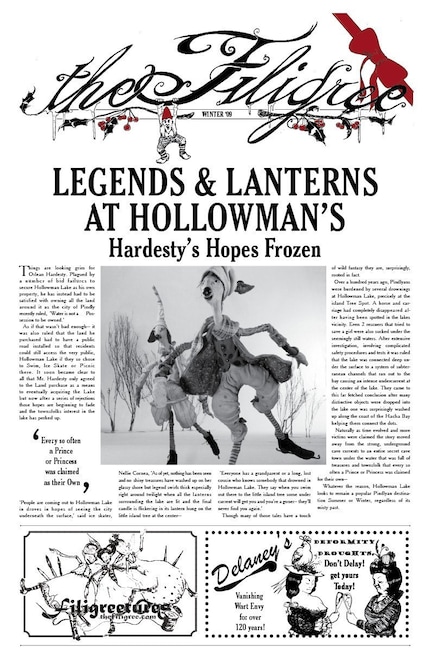
The Filigree is a quarterly fairytale newspaper packed with articles inspired by fairy tales, folklore and myth. You'll find everything inside you'd expect in a 'normal' newspaper - including gossip columns, sports, horoscopes, obituaries and classifieds. There are some brilliant adverts too (and some of the goods like 'Sailors N Sirens soap' are actually available to buy in The Fairy Tale General!).

The Spring 2009 issue is currently available as a free download, and you can flip through the Winter 09 issue too, so you can get a taste of all the lovely things inside. The level of detail is amazing, and the whole thing - all of the art dolls, photography, illustration and text - is produced by a husband and wife team in Nashville. Here are some pictures from the paper:


'More Mermaidens Arrested in Concordia Sinking', from Spring 'o9


'Rare Cloud Inspires Lamplighter to Set Sail' from Winter 'o9


'CandyTroll', from Spring 'o9


The Filigree is available as single issues or by subscription (for a very reasonable price) from their store and there is a fantastic gallery to explore on their site too. I'm definitely going to subscribe, I'm really excited about it, so I just wanted to help spread the word!


(all images from The Filigree, used with permission)

Saturday, 16 January 2010

Auditions for a fairy tale film

Please see the information from the fantastic Chagford Filmmaking Group below:

'Sir Lanval' Auditions - Friday 12th February - Venue: London Bubble Theatre Company, 5 Elephant Lane, London, SE16 4JD

The Chagford Filmmaking Group are auditioning for the lead roles in a 52 minute film of a twelfth century fairytale about a handsome young knight who falls in love with a fairy. It is a strong actors' drama with complex characters and relationships set in the court of King Arthur. Filming is in Devon and Brittany in May this year.

The Roles:
Sir Lanval - lead role - a young knight, playing age 20, French accent preferred but not essential, needs to move well and have a certain aura of innocence and beauty (sufficient to attract a fairy!)
Tryamour - the Fairy Queen, playing age 20, ability to dance preferred but not essential.
King Arthur - playing age 40, minimum height 5 ft 10.

Fee £500.

Preparation - we will email lines to learn and a synopsis of the story.

We also have other speaking parts to cast from amongst the auditionees although these will be unpaid. Expenses will be paid.

Shooting dates 16th-30th May 2010 with a 4 day intensive rehearsal weekend 23rd-26th April.

The budget for the film is around £20,000. The 58,000 euro award also covers a book, an exhibition, and the distribution of DVDs of the film to tourist centres across England and France.

Our co-partners are "Le Centre d'Imaginaire Arthurien" in Brittany.

Contact Alex at info@fairytalefilms.co.uk. Please include a photograph and CV. You can find more information on the project here.

Chagford Filmmaking Group is a non-profit organization dedicated to films of British fairytales. Sir Lanval is made possible by grants from the European Regional Development Fund and South West Screen.

Thursday, 14 January 2010

Lots of lovely things to read....

I'm currently battling with essay deadlines so I haven't got the time to present these links in the kind of posts they deserve, but three wonderful looking fairy tale reads have appeared in the last few days:


The new issue of Goblin Fruit, the fantastical poetry zine, which has been guest edited by Mike Allen of Mythic Delirum fame.


The new issue of Scheherezade's Bequest from the brilliant fairy tale journal Cabinet Des Fées.


And the fantastic looking Fairy Tale News New Year's Bumper Edition from Once Upon a Blog.


I can't wait to delve in!
- as soon as I've finished the essays :-(

Sunday, 10 January 2010

Marina Warner on the RSC's Arabian Nights

It's been a fantastic season for fairy tale theatre in the UK, as well as the ubiquitous pantomime there have been many exciting productions drawing on fairy tales and folklore. I've been lucky enough to see two of them - The Library Theatre's Grimm Tales (deliciously dark with a great selection of tales) and En Masse Theatre Company's The Wonderful Wizard of Oz (enjoyable and inventive - the audience all had to don green lensed glasses when Dorothy and friends reached The Emerald Kingdom!).

One other production I would love to see is the RSC's Arabian Nights. Marina Warner wrote an article about it in yesterday's Guardian. She reviews the production and she also gives us some fascinating tidbits of the history of the Nights on stage, here's just a taste:
'In the theatre especially, the sheer abundance of the plots of the Nights opened up possibilities: the book presented magical twists and turns that intrinsically lent themselves to high-spirited performance and to technical experiment. The history of the Nights on the stage is consequently intertwined with some brilliant early stagecraft for transformation scenes, flying machines, conjuring illusions, innovatory limelight and other effects (in Islington in the 1890s, the genies in Aladdin were called after the new gases, Paraffin, Benzoline and Colza).'
The Arabian Nights is on at the RSC's Courtyard Theatre until the 30th January. And although the glut of seasonal fairy tale shows has now nearly passed there is Andersen's English to look forward to - a new production by Out of Joint, written by novelist Sebastian Barry:
'Celebrated children's writer Hans Christian Andersen arrives, unannounced, for a stay at Gad's Hill Place in the Kent marshes - home to Charles Dickens and his large, charismatic family.

To the lonely and eccentric guest, the members of Dicken's household seem to live a life of unreachable bliss. But with his broken English, Andersen doesn't at first see the tensions in the family: undeclared passions, a son sent to serve in India, and a growing strangeness at the heart of Dickens's marriage.'
This should be interesting, especially as the relationship between the two writers soured after this visit. The production will be touring in Spring 2010.

(ps - If you follow the link to the Guardian to read Marina Warner's article I'd also recommend Margaret Atwood's plea for birds, which made me think of her beautiful essay 'Of Souls as Birds' in Mirror, Mirror on the Wall, in which she explored her love of fairy tales in which people are transformed into birds)

Tuesday, 5 January 2010

The Fairy Tale Project

Just came across this intriguing fairy tale project, in which each artist is contributing a paragraph and an illustration to the story before it is passed along to someone else. The story takes a new turn with each contributor and there are some lovely illustrations - definitely one to follow.

Enchanted Conversation - The Sleeping Beauty Issue


Enchanted Conversation is a new blogazine dedicated to fairy tales. Each of the quarterly issues will be dedicated to a particular fairy tale and feature an eclectic mix of fiction, poetry, articles, essays, art and reviews.

In The Sleeping Beauty Issue there's lots to enjoy, including recipes to feed a castle full of people who've just woken up from a 100 year sleep (A Royal Awakening), the real bad fairy confesses - and it isn't the one you'd expect (The Twelfth Fairy Confesses), one princess is starved of stories (Apathy), and another questions the fairy tale ending (Happily Ever After), we learn about Steampunk + Fairy Tales and there's much, much more.

The issue also looks beautiful, I love the way editor Kate Wolford has included a mix of classic and contemporary illustration, along with fabulous etsy buys.

The magazine is based on a blog to encourage participation, readers are encouraged to comment on the contents and enter the conversation about the featured tale, there are contests you can enter too.

The next issue will be focused on Beauty and the Beast and you can find the submissions info here.

Friday, 1 January 2010

New Fairy Tales Competition - winners picked...


...from inside my favourite pair of socks.


The wonderful 'New Fairy Tale Nymph' will be winging its way to Samantha in the UK.


The fantastic fairy tale Ream will be flying to Christina in Australia.


Congratulations to the winners!!! And thank you so much to everyone else who took the time to donate to Derian House.

As a special thank you runners up will also be receiving a little set of New Fairy Tales postcards.

I'd also like to say thank you to Particle Article - without their generosity the competition wouldn't have been possible. You can see more of their fantastical creatures here and if you'd love one for yourself (I would!) you'll find a list of their stockists here.

And thank you also to Oona Patterson, who has sent a beautiful signed card to go with Ream to make it extra special. If you'd like a copy of the book (a new year treat!) you can buy it here and you can see more of her amazing work here.

Happy New Year! May the new year bring you what you wish for - and remember to wish wisely!

Wednesday, 23 December 2009

Merry Christmas everyone


and very best winter wishes.
See you in 2010.
Claire x


ps there's still time to enter the New Fairy Tales competition, all the details you'll need are here.

Monday, 21 December 2009

Queens of snow and ice


When I was little I could see two hills from my bedroom window and I was convinced that the White Witch from the Narnia books lived between them (I also spent a lot of time trying to get through the back of wardrobes). I wasn't scared of her - I wanted to find a way to visit her. There's something about cold queens, ice queens that has always fascinated me. When Edmund first meets the White Witch, who has imposed eternal winter (without Christmas) on Narnia, we are told 'Her face was white - not merely pale, but white like snow or paper or icing-sugar, except for her very red mouth. It was a beautiful face in other respects, but proud and cold and stern.'

Her entrance, in a sleigh, is so similar to Hans Christian Andersen's 'The Snow Queen' (1845) that it seems impossible that Lewis was not influenced by the earlier story. Though unlike the White Witch the Snow Queen is actually made of ice:
'This snow-flake grew larger and larger, till at last it became the figure of a woman, dressed in garments of white gauze, which looked like millions of starry snow-flakes linked together. She was fair and beautiful, but made of ice—shining and glittering ice. Still she was alive and her eyes sparkled like bright stars, but there was neither peace nor rest in their glance.'
Andersen's Snow Queen sits in her palace on a frozen lake which she calls 'The Mirror of Reason' and so, cold and barren, she embodies Andersen's ideas about reason and science. But he also created another ice woman - 'The Ice Maiden' (1861) - who he uses for the opposite role - she represents the forces of nature and is the enemy of reason, although she also has to have what she wants...
'Ice Maiden—the queen of the glaciers. It is she whose mighty power can crush the traveller to death, and arrest the flowing river in its course. She is also a child of the air, and with the swiftness of the chamois she can reach the snow-covered mountain tops, where the boldest mountaineer has to cut footsteps in the ice to ascend. She will sail on a frail pine-twig over the raging torrents beneath, and spring lightly from one iceberg to another, with her long, snow-white hair flowing around her, and her dark-green robe glittering like the waters of the deep Swiss lakes. “Mine is the power to seize and crush,” she cried. “Once a beautiful boy was stolen from me by man,—a boy whom I had kissed, but had not kissed to death. He is again among mankind, and tends the goats on the mountains. He is always climbing higher and higher, far away from all others, but not from me. He is mine'
'The Ice Maiden' was inspired by the death of Andersen's father, which he talks about in his autobiography The True Story of my Life:
"He is dead," said my mother, addressing it; "thou needest not call him. The ice maiden has fetched him."

I understood what she meant. I recollected that, in the winter before, when our window panes were frozen, my father pointed to them and showed us a figure as that of a maiden with outstretched arms. "She is come to fetch me," said he, in jest. And now, when he lay dead on the bed, my mother remembered this, and it occupied my thoughts also.'


Snegurochka, a woman made of snow, rather than ice, appears in Russian fairy tales; in one variant, 'The Snow Maiden', she is fashioned from snow by an old childless couple, and in the Russian festive tradition Snegurochka is the granddaughter and assistant of Ded Moroz, Grandfather Frost, the Russian equivalent of Father Christmas (you'll find lots of lovely illustrations of her in a post on A Polar Bear's Tale). In contrast to the cold women I've mentioned above the Snow Maiden is kindlier, and made to suffer by others, and hers is not a happy ending because snow melts too easily.

Ice is hard, sharp and clear; it offers an illusion of permanence - it reminds us of glass. It is this last similarity that A.S. Byatt has played on to wonderful effect in the fairy tale 'Cold', from her collection Elementals. In the tale, Fiammarosa, a princess descended from an icewoman, is docile and doughy when kept in the warmth, but she is enlivened by the cold, and once she discovers this she escapes the palace at night to dance in the snow...
'And one night, as she moved, she found that her whole body was encased in a transparent, crackling skin of ice, that broke into spiderweb-fine veined sheets as she danced, and then reformed. The sensation of this double skin was delicious. She had frozen eyelashes and saw the world through an ice-lens'
Yet she falls in love with Sasan, a desert prince, wooed by his amazingly intricate glass sculptures. She sees the resemblance between glass and ice but she knows nothing of the dangerous heat that glass must be formed in.

Byatt has said the tale is about her relationship to writing, and in her essay 'Ice, Snow, Glass' in Mirror, Mirror on the Wall she says that even as a girl she knew that 'there was something secretly good, illicitly desirable, about the ice hills and glass barriers.' She later says:
'The frozen stony women became my images of choosing the perfection of the work, rejecting (so it seemed to me then, though I have done my best to keep my apple and swallow it) the imposed biological cycle, blood, kiss, roses, birth, death and the hungry generations.'
Fiammarosa also finds a compromise, although this has to be within the confines of a chilled palace in the heart of a mountain, at the edge of the desert kingdom:
'And if Fiammarosa was sometimes lonely in her glass palace, and sometimes wished both that Sasan would come more often, and that she could roam amongst fjords and ice-fells, this was not unusual, for no one has everything they desire. But she was resourceful and hopeful, and made a study of the vegetation of the Sasanian snow-line, and a further study of which plants could thrive in mountain air under glass windows, and corresponded - at long intervals - with authorities all over the world on these matters.'
It seems there is a choice for ice queens, who think, as Fiammarosa does at first, that there is 'more life in coldness. In solitude. Inside a crackling skin of protective ice'. They can stay out in the cold, or, take the risk of melting a little, but either way happiness comes and goes in flurries, just like the snow.


A few other icy paths to travel...
The Snow Queen in a beautiful digitised copy of Stories from Hans Andersen, illustrated by Edmund Dulac.
A lovely digitised copy of The Ice Maiden.
The Snow Queen, a poem by Jeannine Hall Gailey from the JOMA archives.
This week is Snow Queen week on the SurLaLune blog and Heidi Anne Heiner will be featuring several of the adaptations of the tale.

Thank you to Graham Dean and Louise Dean for the fantastic photographs!

Sunday, 20 December 2009

What happened to Cinderella?

There was a new Cinderella story in yesterday's Guardian by Man Booker prize winner Hilary Mantel, with lovely illustrations by Posy Simmonds.


'Cinderella in Autumn' is an intriguing look at life for Cinderella 20 years after the wedding. The story is shot through with references to our times - Cinderella is stalked by paparazzi, her remaining stepsister is hoping the Tories get in, and the prince runs a scheme for young people involving white water rafting that 'brings out your potential and fits you for a destiny'. And we discover that the Prince has always had more of a relationship with her shoes than with Cinderella herself: 'She would see him, in absent moments, caressing the glass heel, which would seem to grow higher under his fingertips.'

I'm not going to say too much more because it's a good read, and I don't want to spoil it, but I do like the way Mantel has used the story to comment on our fame obsessed culture and the depressing fact that, for some girls, marrying a prince (or sleeping with a golfer) might still be thought of as the best route to happiness.

Monday, 14 December 2009

Grimm Tales

I went to see Grimm Tales at Manchester's Library Theatre last week and it was fantastic! Energetically performed and deliciously dark - it was great to see the Grimm's tales getting an outing with the grim bits left in.

First performed in 1994 at the Young Vic, the play was adapted from the Grimm's tales by Carol Ann Duffy and dramatised by Tim Supple. This production has been directed for the Library Theatre by Rachel O'Riordan and is engagingly performed by eight actors, dressed like a raggedy troupe of storytellers, who dance, act, make music and tell the tales with relish.

One of the things I really enjoyed was the eclectic selection of tales; there was a real mix of the familiar and the unfamiliar. I also thought the inclusion of Ashputtel and The Lady and the Lion worked well as people are usually more familiar with their French literary predecessors, Cinderella and Beauty and the Beast.

Here are the Grimm's tales that are used in the show in versions that are available online:

Hansel and Gretel (here I've linked to a page that gives translations of both the 1812 and 1857 versions - which makes for very interesting reading)
The Golden Goose
Ashputtel
Iron Hans
The Mouse, the Bird and the Sausage
The Lady and the Lion (also known as The Singing, Springing Lark)
Little Red Cap

I'd also really recommend Carol Ann Duffy's book Rumpelstiltskin and other Grimm Tales (1999) which includes her versions of all of the above (apart from The Mouse, the Bird and the Sausage), and many more, and is a delight to read.

There's an interview with Duffy on the Library Theatre website, in which she talks about how she went about retelling the tales.

I've also written a review of the show for a site called Artsphere here.

Grimm Tales is on at The Library Theatre until 23rd January - get there if you can!

Monday, 7 December 2009

Moss Witch by Sara Maitland

I just wanted to draw your attention to a wonderful story that is on the shortlist for the BBC National Short Story Award and currently available to listen to online, or download, as a podcast.

'Moss Witch' is set in a remote tract of ancient woodland in Western Scotland and involves an encounter between a young bryologist (his hair, 'the colour of winter killed bracken') and a Moss Witch (her face, 'carved with long wrinkles running up and down her forehead and cheeks'). The story is beautifully read by Hannah Gordon and I'm not going to give anything else away because I don't want to spoil it, you will just have to listen to it. Even better, listen to it and buy the book it's published in too (details below).

There is something so magical about moss; I grew up in a house beside a wood, and even in the dead of winter, when empty branches let through so much stark grey sky, and the air is bitterly cold, there is a softness to the wood where the ground is carpeted, and the trees clothed, in moss. I'm sure moss softens sounds too, creating a special hush and adding a sense of otherworldliness to the places where it thrives and hides. 'Moss Witch' captures this perfectly.

Author Sara Maitland, a writer of novels, short stories and non-fiction, is no stranger to writing fairy tale and folklore inspired fiction (see her two most recent collections Far North & Other Dark Tales and On Becoming a Fairy Godmother). She is also currently working on a book about fairy stories and forests.

'Moss Witch' is published in When it Changed, an anthology edited by Geoff Ryman, and published by the brilliant Comma Press, a Manchester based independent publisher who have a talent for bringing wonderful books into being (I've read two of their other books this year Under the Dam, by David Constantine and Stone Tree, by Gyrðir Elíasson, which if you love haunting, well-crafted short fiction I'd highly recommend).

When it Changed is the result of a collaboration between writers and scientists 'Composed collaboratively – through a series of visits and conversations between leading authors and practicing scientists – it offers fictionalised glimpses into the far corners of current research'. Maitland effortlessly combines the scientific detail, I imagine she gleaned from her scientist, with magical prose.

I urge you to listen to 'Moss Witch' when you get a quiet moment. I've only really discovered the delight of listening to audio stories this year, and I find that especially when my eyes are too tired to read, but I'm still longing for a story to help me divide work from sleep, they are the perfect accompaniment to a bath (be sure to cleverly wrap your MP3 player though - I've already lost one to steam damage!).

You can download or listen to 'Moss Witch' and the four other finalists here.

The winner will be announced live from the awards ceremony tonight at 7.15pm on BBC Radio 4's Front Row.

I'm keeping my fingers crossed for Sara Maitland!


The photograph is of a tree in the woods by the house I grew up in.

Thursday, 3 December 2009

Marina Warner podcast

Marina Warner's recent lecture ‘Figures in the Carpet: Magic and the 1001 Nights’, which I blogged about here, is now available as a podcast.

If, like me, you love books of hers, such as From the Beast to the Blonde and Phantasmagoria, then you'll really enjoy this (and if you haven't read those books you definitely should!). Warner has a wonderful way of bringing together all kinds of fascinating tidbits from the realms of history, culture and myth, and exploring the connections between them in an engaging and enlightening way.

In this lecture she examines the magic of the flying carpet, from its earliest association with Solomon, through its appearances in the Nights, and in its ongoing influence as a 'metaphor activated as fact'. She explores human fantasies of flight, and some of the other domestic flying vehicles of folklore (including beds and sofas), before settling on Freud's couch and the importance of its own 'magic carpet'.

You can listen to or download the podcast from the Queen Mary, University of London website here.


Photograph by Elke Bock 2003

Fundraising exhibition for The House of Fairy Tales