Monday, 3 January 2011
a new year and a new blog
For the time being I am going to put The Fairy Tale Cupboard into hibernation. The eagle-eyed may have noticed I haven't been posting very regularly recently. I've found it harder and harder to justify posting and keeping the listings up-to-date when I could be spending the tiny scraps of time I get to myself actually writing stories, which is what I most want to do. Also, I am passionate about fairy tales, but I'm passionate about the other types of fiction I read, write and edit too, and there have often been things I've wanted to post about that didn't really fit here. So, over the last couple of months I have been cautiously (and secretly) posting over at a new blog called Gathering Scraps. This one will mention fairy tales from time to time and it will gather together lots of other bits and bobs too. And, rather than allowing it to distract me from writing, I'm going to try to post more about what has been inspiring me and feeding into my work.
Thank you for reading, for linking to The Fairy Tale Cupboard and for all your kind and insightful comments. It has been a pleasure getting to know people through writing this blog.
I hope the year ahead brings you lots of happiness and everything you need.
Very best wishes,
Claire
Thursday, 23 December 2010
The best place by the fire...
I first watched the series on tv when I when I was seven, then somehow over the years I forgot all about it. When the lovely Faye Durston and Cate Simmons mentioned it to me earlier this year I still couldn't remember it, but the second I saw the opening on YouTube I was transported straight back into this magical world. Below is one of my favourite episodes. I think it's important we share The Storyteller so that he can't be forgotten. Hope you all have a wonderful, warm and happy festive season!
Wednesday, 1 December 2010
New Fairy Tales Issue 6 now online
And here is the issue itself...
Thursday, 25 November 2010
Chagford Filmmaking Group
Chagford Filmmaking Group, the intrepid group of fairy tale filmmakers from Devon, have got lots of exciting things going on at the moment. The clip above is the opening of their first feature film, Sir Lanval, a twelfth century fairy tale. They shot it in fifteen epic days in two countries on a budget of just £25,000!
This weekend, as part of the Fantasy, Faeirie and Visionary Arts event at the Flavel Arts Centre in Dartmouth, there is a Talk On The Filming of Sir Lanval by Elizabeth-Jane Baldry (director and co-writer of the film) on Saturday at 12noon. This will include clips from the film and a chance to hear about behind-the-scenes adventures, and tales of pigs, maggots and magical white horses appearing from nowhere. On Sunday 28th at 11.30am, there will be a Screening of Peerifool: An Orkney Fairytale - a tremendous tale about three little girls who outwit an ogre. And it's full of porridge fairies! (Film duration = 40mins).
Also currently at the Flavel is an Exhibition of Costumes and Other Delights from the film, which runs until the end of the month. And at Exeter Castle the Shared Legends Exhibition of newly commissioned artworks inspired by the Lanval story opens on the 6th December and runs until the 18th. And it features the work of internationally known painters, sculptors, and graphic artists such as Brian Froud, Wendy Froud and Alan Lee as well as young rising stars in the mythic arts field (there is a wonderful post by Rima Staines over at The Hermitage about her experience of creating work for the exhibition).
This is all part of the group's Shared Legends Project, a unique cultural exchange between two countries that share a rich mythic heritage, which has been funded by the European Union and South West Screen.
Monday, 22 November 2010
'Happily Ever After' exhibition

'Happily Ever After' an exhibition of work by Su Blackwell opens at the Long and Ryle Gallery on Thursday 25th November and runs until the 18th December, 2010
Su says...
As in many recent works I will be focusing on fairy tales, with their haunting, dream-like atmosphere. This exhibition broadly explores the role of marriage within the fairy tale. In many fairy tales, marriage acts as a kind of a closing sequence for the “happy ending”, simply because it was an expected stage of life for women during the periods in which these tales were first told. In these new works, I question a different type of ending.
And the Long and Ryle site gives an insight into the way Su works...
Using a scalpel she cuts and glues the pages of books to create miniature dioramas glowing with lights in wood and glass boxes, like Victorian relics found in a museum of intrigue. She finds her books – or rather lets them find her – by trawling through second-hand book shops. She always reads the book first and this in turn inspires the work.
If you're in London I urge you to get to the exhibition, but if, like me, you're too far away there are at least lots of wonderful pictures to get lost in on Su's site.
Image: Jorinde and Jorindel, copyright Su Blackwell
Wednesday, 17 November 2010
Two fairy tale related calls for papers...

30 March 2011
CALL FOR PAPERS
A one day conference hosted by the School of English, University of St Andrews, Kennedy Hall, St Andrews, Scotland
George MacDonald (1824-1905) is most often discussed in terms of what came after: his role in the development of fantasy literature and his influence on writers such as C. S. Lewis and J. R. R. Tolkien. Though providing valuable insights into MacDonald’s legacy, this emphasis tends to obscure his involvement in his own time. MacDonald was a Victorian. His works attest to his wide knowledge of his time and culture, and his deep engagement with the issues of the day.
George MacDonald among His Contemporaries looks to re-establish MacDonald’s place within his own context. We invite proposals for a variety of disciplines for papers and presentations which offer critical reinvestigation of MacDonald’s work. We particularly welcome papers that look beyond MacDonald’s fantasies to consider other aspects of his works.
Relevant topics might include:
- examinations of MacDonald and social issues, such as women’s rights and suffrage, racism and abolition, poverty and social welfare, animal rights, et al.
- genre criticism of MacDonald: historical fiction, sensationalism, romance, et al.
- gothic influences on MacDonald
- medievalism in MacDonald’s poetry and fiction.
- MacDonald and science or pseudo-science: evolution, vivisection, and mesmerism
- MacDonald’s literary criticism
- MacDonald and Victorian readings of Shakespeare
- critical re-examination of MacDonald’s poetry
- the interplay of poetry and prose in MacDonald’s works
- the interfacing of visual arts and MacDonald’s narratives, notably his connection to the Pre-Raphaelites
- MacDonald’s role in the Scottish preaching tradition
- MacDonald in relation to other Victorian literary figures: Dickens, Eliot, Kingsley, the Rossettis, Tennyson, Ruskin, et al.
- MacDonald and Scotland: Burns, Scott, Hogg, the Highlands, et al.
Keynote speakers will be Stephen Prickett and David Robb.
Papers will be 20 minutes. Please submit a 300-word abstract, in .doc, .docx, or .pdf format, with biographical information to Ginger Stelle (gs345 [at] st-andrews.ac.uk) and John Patrick Pazdziora (jpp6 [at] st-andrews.ac.uk) before 15 January 2010.
--------------------------------------------------------A two-day international conference hosted by the Film and Literature Programme of the University of York's Department of English and Related Literature in association with The Centre for Modern Studies
(please note these are the new, confirmed dates and have been adjusted by one day since I first posted this)
CALL FOR PAPERS
This forthcoming conference invites renewed reflection on fundamental, inherited tales as these have found self-reinventing expression in film and literature post-1900. It seeks to interrogate the dramatic, poetic and visual character of culturally core stories (fairy/mythic/classical/religious/Shakespearean etc), the formal operations and cultural force of their variant tellings (and showings) across media and moment, and the ways in which their psychological, social, political and aesthetic functions have been interpreted and employed.
Abstracts are solicited for individual 20-minute papers on the theme of the conference (interpreted in literary or film terms, or both). Proposals of pre-constituted panels (composed of two or three 20-minute papers) are also welcome.
Questions informing case studies might include (without being limited to):
- Why do some stories endure across multiple retellings while others fall into neglect?
- What primal impulses are encoded, fears expressed or defused and/or desires satisfied in those that resurface repeatedly in altered guises?
- Which narrative elements and characters have proved largely stable across time and place, apparently immune to cultural disruption, and which have been gently or radically adjusted in response to other cultural-historical forces?
- How have particular post-1900 literary and screen engagements with culturally embedded stories appropriated, revivified and disseminated those inherited tales in distinctive and/or culturally illuminating ways?
- How have the behavioural models promoted, social imperatives implied, modes of telling adopted and artistic allegiances embraced in the ongoing lives of particular tales been revised over time to fit new circumstances, new audiences and new media?
- How have theories of transmission, narrative endurance and narrative change accounted for the culturally revealing reinventions of various fundamental story pools?
- Which theories of narrative transmission, inter-medial adaptation and/or inter-textuality can illuminate the ongoing life of a story most tellingly? (And, perhaps, which have proved interpretively diversionary or limiting?)
Panels have thus far been suggested on the following themes: classical subjects, scriptural/religious subjects, Shakespearean subjects, fairy tales for children, fairy tales for adults, the transculturing of inherited myths. Contributors are welcome to submit with these proposed panels in mind, or in any other area in line with the theme of the conference.
Abstracts of not more than 250 words should be submitted, not by attachment but within the body of the email, to: film-and-literature@events.york.ac.uk
Deadline for receipt of abstracts: Tuesday 21st December 2010.
A brief personal biog-sketch (not more than 100 words) including institutional affiliation, current appointment/stage of study, principal publication(s) (where applicable) and main research interests, should be included in the same email. All submissions will be responded to, and all contributors notified, by Tuesday 11th January 2011. Registration details to follow.
Conference chair: Judith Buchanan (judith.buchanan@york.ac.uk)
Addition to post: There are now more details about the conference here.
Illustration by Dorothy Lathrop from The Light Princess by George Macdonald via the chawed rosin
Thursday, 11 November 2010
New tales online

I have't had chance to dip into these yet because I'm busy putting Issue 6 of New Fairy Tales together, but there are lots of Hansel and Gretel tales to read in Issue 4 of Enchanted Conversation and the first issue of Wildberries, a new journal of mythic fantasy, is now online too.
Illustration by Kay Nielsen, from the book Hansel and Gretel and other Stories by the Brothers Grimm
Tuesday, 9 November 2010
Once upon a time... short story and poetry competition

The Chapel Gallery in Ormskirk, Lancashire are looking for modern fairy tales and winter poems. Here are all the details you'll need to enter:
Two writing options and two age categories per option:
Short Story: A Modern Fairytale. Maximum words: 2000. Submission fee: £5.00. Junior Category entries free.
Poem: A Winter Poem. Maximum lines: 45. Submission fee: £5.00. Junior Category entries free.
Adult Category: Over 16. Junior Category: Under 16.
How to enter:
This competition is open to all UK based writers.
* Work submitted must be original and in English.
* Work submitted must be typed in Microsoft Word using Times New Roman font, size 12pt and double-spaced.
* Work should be stapled, bound or held together in a file. Loose sheets cannot be accepted.
* Include your name, age category, address, phone number and email on a cover page attached to the submission.
* Work must be submitted by post AND email to the Creative Writing Competition, Chapel Gallery (address below) AND via email to chapel.gallery@westlancs.gov.uk by Saturday 8 January 2011.
FREE workshops Places are limited. Book early to avoid disappointment.
Short Story Writing: Skelmersdale Library, Southway, Skelmersdale WN8 6NL. Saturday 27th November, 1.30 to 3.30pm.
Poetry Writing: Ormskirk Library, Burscough Street, Ormskirk L39 2EN. Saturday 4th December, 1.30 to 3.30pm.
Book through Chapel Gallery with £5.00 deposit to be returned at workshop on attendance.
Selection process:
The work will be judged by Professor Robert Sheppard, Professor of Poetry and Poetics and Programme Leader for the MA in Creative Writing at Edge Hill University with Ruth Heritage, Director, They Eat Culture / Lancashire Writing Hub and Helen Juste, Arts Development Manager, West Lancashire Borough Council. Works shortlisted will be displayed at the Chapel Gallery plus participating cafés and libraries.
Prizes:
A Modern Fairytale, Adult Category: £250 A Modern Fairytale, Junior Category: Story to be illustrated
A Winter Poem, Adult Category: £250 A Winter Poem, Junior Category: Poem to be illustrated
All prizewinning works will be published on the Chapel Gallery website and the websites of partners involved in the project. There will be a presentation event where prizes and certificates will be awarded and winners will have the opportunity to have their story or poem read aloud. Successful applicants will be contacted regarding the presentation date.
Tuesday, 2 November 2010
Video from the Boston Book Festival: My Mother She Killed Me, My Father He Ate Me
My Mother She Killed Me, My Father He Ate Me at Boston Book Festival 2010 from Boston Phoenix on Vimeo.
Wednesday, 27 October 2010
Save our forests

I don't think there's anything this vile coalition government we've ended up with here in the UK could do that would surprise me. So they're penalising the poor and the disabled, making them pay for the mistakes of super-rich bankers, they're slyly dismantling the welfare state under the false pretext of it being for our economic good. George Osborne's cuts will devastate lives across the UK, but not, alas, those of the greedy capitalists and idiotic politicians who got us into this mess. Now, looking round for somewhere else to swing the axe, they've hit upon our forests: they want to sell off more than half of them to private firms. This could mean the destruction of ancient forests to make way for golf courses, holiday parks and commercial logging.
Please consider taking a second to sign this petition. We have to start standing up to them on this and on all their other execrable plans.
Illustration 'Forbidden Forest' by Arthur Rackham via Children's Fantasy Illustrations
Wednesday, 20 October 2010
Quick Link: Fairy Tale Review's online goodies
Monday, 18 October 2010
The Word Dress


The dress was made by bridal designer Jennifer Pritchard Couchman from several copies of Angela Carter's Book of Fairy Tales (courtesy of Virago Press). The story I read, 'A Book Tale', was commissioned by Litfest and featured a dress made of grass and rain, a dress made of smoke and feathers, and, of course, a dress made from the pages of books. I love books more than almost anything, but I never expected to end up dressed in them. Wearing a dress made from over 2500 pages was one of the most peculiar and exciting things I've ever done!The Lancaster Literature Festival runs until the 24th October and there are still lots more fantastic events to come, including a reading tonight from Ali Shaw author of The Girl with Glass Feet, and a brilliant looking storytelling event on Wednesday called The Court of the Queen of Claywood Flats. The Word Dress will remain on display in The Storey throughout the festival.
All photographs by Jonathan Bean @Litfest. Creative Commons: some rights reserved.
Friday, 15 October 2010
Quick Link: Silverweed, the beginning

Just a quick note to say that Chapter 1 part 1 of Dorlana Vann's new YA novel Silverweed is now online. She is serialising this dark new take on Little Red Riding Hood on her blog Supernatural Fairy Tales.
Wednesday, 6 October 2010
Fairy tale favourites...
Katherine Langrish, over at fantastic children's literature blog Seven Miles of Steel Thistles, has been kind enough to nominate the cupboard for a Unicorn Glitter Award. The award was set up by fantasy writer Katherine Roberts to celebrate bloggers who 'post in the spirit of the enchanted mists'. To accept the award I need to nominate some favourites. This is a difficult task for me because I am terrible at choosing favourite anythings. So to make it a tiny (and I mean tiny) bit easier I am going to nominate favourites that are fairy tale related and that have a good link or two to go with them...My favourite fairy tale book:
This is almost impossible to decide. To the right is a picture of the fairy tale related books currently living by my feet under my desk (so they are always close at hand!). There are others, too, in piles all over the house. But if I go off the book that is looking most worn, that I turn to most often, that represents everything I love about fairy tales it has got to be The Virago Book of Fairy Tales edited by Angela Carter (it's out of print but has now been published together with the second collection as Angela Carter's Book of Fairy Tales).
Carter was, of course, a brilliant fairy tale writer in her own right (The Bloody Chamber is another favourite) and a translator of tales too. In this book she turned gatherer of tales, and she pulled together an eclectic mix of stories with women at their hearts from all over the world. I love the sections she divided them into, they have titles like 'Brave, Bold and Wilful', 'Sillies' and 'Good Girls and Where it Gets Them'. And her introduction gives a real taste of her knowledge of, passion for, and interaction with fairy tales. This quote, in particular, often comes to my mind:Ours is a highly individualized culture, with a great faith in the work of art as a unique one-off, and the artist as an original, a godlike and inspired creator of unique one-offs. But fairy tales are not like that, nor are their makers. Who first invented meatballs? In what country? Is there a definitive recipe for potato soup? Think in terms of the domestic arts. 'This is how I make potato soup.'This is also the book in which I first discovered Mossycoat, one of my favourite tales (sadly that version is not available online but there is a Philip Pullman retelling here).
My favourite fairy tale film:
Another tough one. From my childhood I would say Labyrinth, after that Edward Scissorhands and, although I still love and watch both of those, for the last few years it has been Pan's Labyrinth (there are some snippets of Guillermo del Toro on fairy tales, and a lot else, over at io9).
My favourite fairy tale poem:
The wickedly good lines 'The small girl smiles. One eyelid flickers./She whips a pistol from her knickers./She aims it at the creature's head/And bang bang bang, she shoots him dead' have been etched on my brain since childhood. The poem is 'Little Red Riding Hood and the Wolf' by Roald Dahl and it's available online, along with a recording of Dahl reading it, here.
My favourite myth or legend:
The Buried Moon, it's a deliciously creepy tale. It was collected in the late 19th century in Lincolnshire, England from a girl of nine who said she'd heard it from her Gran. But in Legends of the Lincolnshire Cars Mrs Balfour noted 'I think it was tinged by her own fancy, which seemed to lean to eerie things, and she certainly revelled in the gruesome descriptions, fairly making my flesh creep with her words and gestures.' It was later collected as a fairy tale by Joseph Jacobs who removed the dialect (that's the version I've linked to above). Jacobs also noted that the tale had an unusually mythic quality.
My favourite enchanted creature:

Trolls. I have never quite stopped believing in trolls. I have to blame this on my parents' insistence that we re-enact Three Billy Goats Gruff whenever we went over a bridge (a tradition I'm continuing with my children). In my teens I loved a slightly bizarre children's programme called The Rottentrolls (which no one I talk to has ever heard of), and as an adult I've discovered John Bauer's wonderful trolls.
And finally, I need to recommend another blog. All the fairy tale blogs I read and enjoy are listed in the sidebar. If I have to pick just one that deserves recognition (they all do really) it is going to be the Fairy Tale Channel for fascinating and informative posts alongside new translations of the Grimms, and of Lithuanian, French and Icelandic tales too. It's a blog I return to frequently and always get enjoyably lost in.
Thursday, 30 September 2010
Lovely things in the post...


The pictures really don't do these fairy tale newspapers justice. The attention to detail is wonderful, contents include articles like 'Baba Yaga still at large', a supplement on contemporary fairy tale literature, patterns and small ads, and each issue comes with a free gift, like an enchanted needle and thread or pre-enchanted nettle yarn. Su has an Etsy shop and you can find out more about Enchanted Times and read some content online here.
And then yesterday this arrived:
The Wychwood Fairies is the first book by Faye Durston, a good friend who is responsible for the fantastic art direction on Issue 5 of New Fairy Tales, the beautiful picture on our homepage and the banner on this blog.
This is like the Jolly Postman for lovers of stunning illustration and all things faerie—envelopes hav
And look, can you spot the New Fairy Tales picture anywhere?
And if I haven't tempted you enough yet, maybe this will...
Quick Link: new issue of Scheherezade's Bequest
Wednesday, 22 September 2010
The Magic Carpet Flight Manual

The name of this programme alone makes me want to listen to it. The Magic Carpet Flight Manual will air online and on the BBC World Service this Friday (times here):
Web-dreaming one day, writer Cathy FitzGerald stumbled on a site belonging to a museum in Iran. It purported to tell the "true history" of the flying carpet and detailed its many uses – military, as a means of aerial attack; commercial, as a vehicle for the transport of goods; and cultural, as a device to help readers in the library at Alexandria reach the high books. The article appeared across the web, rarely with any caveat or credit.
In search of a "real" flying carpet, Cathy tracks down the article's author, Azhar Abidi, who helps her separate carpet fiction from carpet fact. She goes on to meet a physicist working on levitation in the quantum world, and a Japanese astronaut who took a carpet ride in space.
Cathy FitzGerald explores the past, present, and future of the magic carpet and wonders what our desire to defy gravity tells us about ourselves.
I love the term 'web-dreaming', it sounds so much more inspirational and productive than the haphazard, frantic click-throughs I too often indulge in. Web-hunting, web-scrounging, web-sifting, web-tunnelling all come more easily to my mind, but from now on I will only web-dream. Funnily enough I came across the peculiar museum website mentioned a while ago whilst researching magic carpets for a previous carpet post.
The author of the fictional history of the carpet Azhar Abidi is a writer, born and raised in Pakistan, who now lives in Australia (thanks to Matt at Books and Adventures for the link to his blog). Marina Warner has also been interviewed for the programme and her fascinating podcast on magic carpets, which is well worth listening to, is still available online here.
Photograph by churl CC license: some rights reserved.
Friday, 17 September 2010
Dresses in fairy tales

I have been thinking a lot about dresses recently because I've been commissioned by Lancaster Literature Festival to write a contemporary fairy tale featuring a dress made from the pages of old books. The dress itself is being made by designer and dressmaker Jennifer Pritchard Couchman, it will be exhibited throughout the festival and I get to wear it to read the story(!).
When I first started pulling together ideas for the tale I couldn't get the Disney Cinderella ball gown out of my head, which bothered me. A lot. I'm not a fan of the Disney versions of fairy tales, or of clothes worship or fashion in general. For the past four years I've spent most days dressed in scruffs accessorised with baby sick, snot, paint and porridge (in various combinations) and not been that bothered about it. But I can't deny the power of a beautiful dress.
Disney Princess culture may be malign, with its sparkly nylon tentacles gripped round the world's little girls (and their parents' credit cards), but Disney didn't invent the idea of the fairy tale dress as a garment of transformation. In the Perrault version of Cinderella, from 1697, Cinderella actually gets to wear two dresses to two balls, and after having her 'nasty rags' transformed into clothes made of 'cloth of gold and silver, all beset with jewels' by her godmother she silences the ballroom with her beauty and the King's son falls for her on first sight. (For an excellent dissection of the problems with this version, and the multitude of versions it's inspired, and a look at some more positive Ash Girl heroines I'd recommend Terri Windling's excellent essay Cinderella: Ashes, Blood, and the Slipper of Glass.)
In the Grimms' version of the tale the maltreated Ashenputtel gets to go to three dances
and wear three dresses, each more magnificent than the last. There is no godmother but instead a little white bird, which brings the dresses when Ashenputtel makes a wish beneath the hazel tree she has planted on her mother's grave. And we're told 'when she went to the festival in the dress, no one knew how to speak for astonishment'.In fairy tales spectacular dresses aren't only a magic ticket to get you into a ball, they can also be an important tool for bargaining with. In The Singing, Springing Lark the heroine finds her husband (who used to be a dove who used to be a lion who was really a prince) is about to be married to another woman, a princess (who used to be a dragon). She uses a dress given to her by the sun and 'as brilliant as the sun itself' to get a night with her lost husband...
The dress pleased the bride so well that she thought it might do for her wedding-dress, and asked if it was for sale? "Not for money or land," answered she, "but for flesh and blood." The bride asked her what she meant by that, so she said, "Let me sleep a night in the chamber where the bridegroom sleeps."In Donkeyskin the beleaguered princess whose father wants to marry her is advised by her godmother to ask for a dress that can't be made. So she tells him she can't give him an answer until he has presented her with a dress that matches the sky, and when (after much coersion) he manages to get her a dress which looks 'as if it had been cut straight out of the heavens' she asks next for a dress of moonbeams and then one of sunshine. Each impossible dress is brought to her and it is instead the skin of an ass which affords her escape from the situation. Although, of course, the beautiful dresses come in handy for the happy ending.
Donkeyskin's fantastical sky dresses bring to my mind Max Lüthi's comments on dresses in fairy tales in Once Upon a Time On the Nature of Fairy Tales:
And in another Greek fairy tale, a fig, a nut, and a hazelnut each contain a dress. On one “the month of May could be seen with its flowers”; on the second “the heavens could be seen with its stars”: and on the third “the sea could be seen with its waves.” One cannot express more beautifully how the world is woven into the clothing of man in the fairy tale, how the enormous patterns of the cosmos are connected with man in a manageable and beneficial form, and how man is securely established in the realm of heaven and earth, and assimilates them both.Whilst I've been writing my tale featuring dresses for the festival, I've collected together all kinds of dress links and other bits and bobs in an online scrapbook to inspire me. And I've discovered the taste for impossible dresses isn't confined to fairy tales, there have been real fads for dresses made of glass and of paper, there have been dresses made of chocolate and even hair.
The story I read will just be one of the fairy tale elements of the festival. Carol Ann Duffy will be reading her fairy tale The Princess' Blankets, Ali Shaw will be reading from his haunting novel The Girl with the Glass Feet, and Sara Maitland, author of many fairy tales, will be reading as part of the Great Short Fiction Day. And storyteller Dominic Kelly will be sharing Mossycoat with under 5s and their grown ups. And that's all just a fraction of what's going on in the wider festival which runs from the 15th to the 24th October. The full brochure is available here.
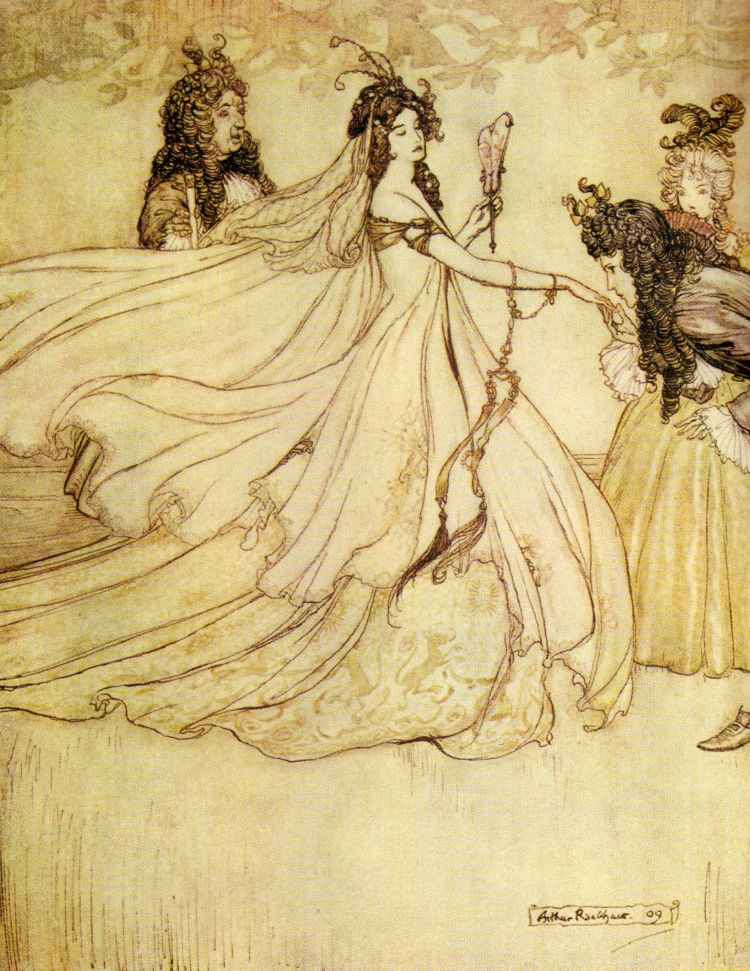
Both of the illustrations in this post are of the Grimms' tale Ashenputtel, the first by Arthur Rackham and the second by Elenore Abbott.
Quick Link: Fairy Tale Reflections
Sunday, 5 September 2010
New Fairy Tales - call for submissions
We are now inviting submissions for our sixth issue. You can find the full submission guidelines here. The deadline is the 20th October and the issue is due out at the end of November. Looking forward to reading your tales!The beautiful picture above is by our very lovely art director Faye Durston.