
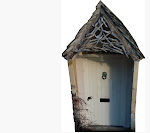
 Robert Powell, Lance, 2008, watercolour etching
...most intellectual development depends upon new readings of old texts. I am all for putting new wine in old bottles, especially if the pressure of the new wine makes the old bottles explode...
—Angela Carter, 1983
Over the course of two days there were 23 papers, 2 plenaries, an artist's talk and 3 fiction readings given. Researchers came from a range of disciplines and from universities around the world. Happily many of the papers given will be collected together and published by Cambridge Scholars publishing in 2011. I can't possibly do justice to everything that went on, so I'm not going to attempt to. I do hope the following links may be of some use though...
(apologies that this is in no particular order, and messy, like my notebook)
Tales and books I now want to read:
- After hearing about Nalo Hopkinson's reimagining of Bluebeard in a postcolonial setting 'The Glass Bottle Trick', in a paper by Natalie Robinson, I really want to get my hands on Hopkinson's collection Skin Folk.
- One of my favourite papers was Dr Jessica Tiffin's exploration of the vampiric versions of Snow White by Neil Gaiman and Tanith Lee, and of the unusual interplay between the gothic and fairy tale elements in these tales. I now really want to read Tiffin's examination of narrative and metafiction in modern fairy tale Marvelous Geometry.
- 'A Suburban Fairy Tale' by Katherine Mansfield, covered in a paper by María Casado, is a brilliant tale I'd not come across before and really should have. It's available to read online here.
- I was intrigued by humorist James Thurber's tales, covered in a paper by John P. Pazdziora. Thurber has been named as an influence by Neil Gaiman and I definitely want to read more.
- Hearing about Rikki Ducornet's tales, in a paper by Dr Michelle Ryan-Sautour, was a revelation for me. Why had I never heard of Ducornet before?! I am now desperate to read her collections The One Marvelous Thing and The Complete Butcher's Tales. Hunting for info on her online I've come across this interview and this electronic chapbook (which features several of her tales and some of her artwork for the wonderful Borges story 'Tlön, Uqbar, Orbis Tertius'). Ducornet is also the illustrator for Kate Bernheimer's forthcoming collection of fairy tales Horse, Flower, Bird (another book I want!).
Some of the other writers covered (whose work I was already more familiar with) included A S Byatt, Roald Dahl, Sara Maitland, Margaret Atwood and, of course, Angela Carter.
Art and the anti-tale:

As well as literature we were treated to several papers on the anti-tale in the work of visual artists such as Dorothea Tanning (I have included her painting Birthday, to the right) and Paula Rego. The symposium also had a resident artist, Robert Powell (I've included an image by him at the top of this post). He is currently exhibiting his stunning work at the Henderson Gallery in Edinburgh.
In terms of film, a paper by Professor Suzanne Buchan on the Quay Brothers' Street of Crocodiles, followed by a screening of the film was a real treat. Buchan's paper also included what has to be my favourite quote from the symposium, taken from the Selected Writings of Walter Benjamin:
Children are fond of haunting any site where things are being visibly worked on. They are irresistibly drawn by the detritus generated by building, gardening, housework, carpentry, tailoring or whatever. In these waste products they recognize the face that the world of things turns directly and solely to them. In using these things they do not so much imitate the works of adults as bring together materials of widely differing kinds in a new volatile relationship. Children thus produce their own small world of things within the larger one. The fairy-tale [sic] is such a waste product—perhaps the most powerful to be found in the spiritual life of humanity: a waste product that emerges from the growth and decay of the saga. With the stuff of fairy-tales the child may be as sovereign and uninhibited as with rags and building blocks. Out of fairy-tale motifs the child constructs its world, or at least it forms a bond with these elements.
(I found the quote online, in a paper by Buchan on 'Animation Spectatorship: The Quay Brothers' "Animated Worlds"', in EnterText journal)
So what is an anti-tale?
I'
 m not a literary theorist, or fairy tale scholar, I research fairy tales for fun (and get a lot of inspiration from them for my own writing along the way). Whilst the term anti-tale was used and applied widely at the symposium I think everyone had their own particular idea of what it means. Retellings, reimagnings, subversions, new tales—all can come under the banner of anti-tale if they are employing motifs, or themes, or characters from the glorious ragbag of traditional tales in non-traditional ways.
What the symposium brought to light, for me, was the sheer abundance of anti-tales in literature and art. And although anti-tales can be identified as being contemporaneous with the oldest known fairy tales, within 20th and early 21st century literature they would seem to be the dominant of the two forms.
Anti-tales and fairy tales draw from the same well of material, but, perhaps, where a fairy tale dips a sturdy wooden bucket beneath the surface, the anti-tale is as likely to use a glass bucket, or a plastic sandcastle one, or a shoe. We are lucky to have such a diversity of tales to treasure.
Many thanks to symposium co-organiser Catriona McAra for sending the photo of me above, and to her and David Calvin for such a fantastic event in all respects!




 Posts


